Bid, ask and spread: what a round trip actually costs
Translate a two-sided FX quote into pips and cash, and avoid subtracting the same spread twice.
Read the two sides before calculating
A two-sided quote describes different prices for buying and selling. The bid is the buying side of the quoted market; the ask is the selling side. A customer buying at the displayed ask and selling at the displayed bid crosses that difference. Investor.gov calls the difference the spread. Its glossary describes securities; actual FX quote conventions and executable quantities must be checked with the provider. A chart showing one number is not necessarily showing the price available for both directions.
Work through a hypothetical unchanged quote
Suppose EUR/USD is quoted at a bid of 1.1000 and an ask of 1.1002, and both prices remain unchanged for this example. The difference is 0.0002 USD per EUR, or two conventional EUR/USD pips. Buying 10,000 EUR at the ask and immediately selling the same quantity at the bid produces (1.1000 − 1.1002) × 10,000 = −2 USD before other costs. The example assumes the entire quantity can execute at those prices. It is not a live quote or a statement about any broker.
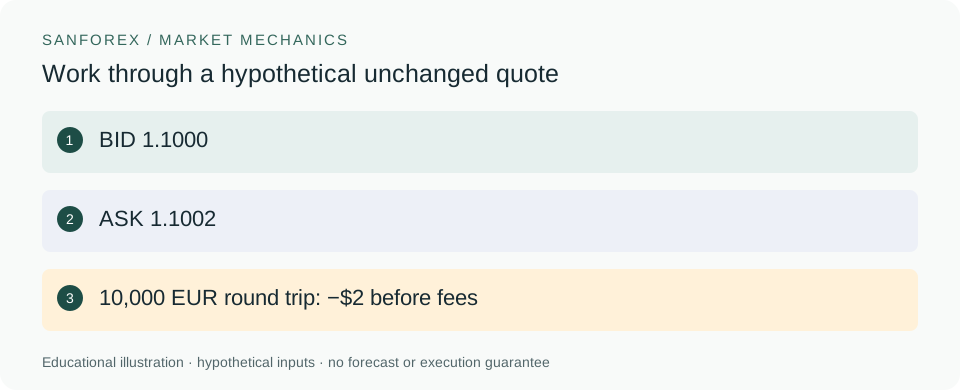
Hypothetical example: BID 1.1000. ASK 1.1002. 10,000 EUR round trip: −$2 before fees.
Open full-size diagram ↗Separate spread from commission
If that same hypothetical round trip also incurs a 0.50 USD commission on entry and 0.50 USD on exit, the net result is −3 USD. The price difference already accounts for the 2 USD spread effect. Subtracting another 2 USD spread allowance would count it twice. For a planning worksheet based on a midpoint rather than executable fills, a separate spread assumption can be appropriate; write down the price basis first so that the two methods are not mixed.
Check quantities and units
Under the illustrative 100,000-base-unit lot convention, the 10,000 EUR position is 0.10 lot. Its conventional pip value is 1 USD, so two pips correspond to 2 USD. If the account currency is not USD, convert that cash amount using an explicitly stated rate. Do not assume a pip is the final displayed decimal or that a metal or index contract follows the FX convention. SanForex’s pip-value calculator can check the unit conversion; it does not retrieve an executable bid or ask.
Keep an execution record that explains the difference
For your own review, retain side, quantity, requested price, fill price, timestamp and each separately charged fee. Compare records from the same instrument and source. A changing quote, partial fill or different execution price invalidates the unchanged-quote assumption above. Do not interpret a small displayed spread as proof of low total cost: commissions, conversion and financing can sit elsewhere on the statement. The useful outcome of this worksheet is a reconciled explanation, not a promise that a future trade will cost the same amount.
Sources and conventions
Examples are hypothetical. Worked examples state their formulas and assumptions in the article; our methodology explains the related calculators. Broker contract specifications determine actual lot, margin and execution conditions. These sources document definitions and data; a source link does not imply endorsement of SanForex or a trading service.
These materials are prepared with AI assistance and checked against worked examples and deterministic calculation tests where applicable. They are not an expert suitability assessment or investment advice.
Open pip value tool ↗