CPI index levels, monthly inflation and annual inflation
Distinguish an index level from a percentage change and avoid mixing monthly, annual and seasonally adjusted series.
Identify the series before reading the headline
CPI is published as an index, and changes in an index can be expressed as percentages over different periods. BLS publishes multiple CPI series, so record the population coverage, geography, item grouping and seasonal-adjustment status before comparing values. An index level is not itself an inflation percentage. This guide uses deliberately invented index values to demonstrate arithmetic; it is not reporting the latest inflation release or predicting an exchange-rate reaction.
Calculate a one-month change
Suppose the same hypothetical index rises from 300.0 to 303.0 over one month. Calculate (303.0 ÷ 300.0 − 1) × 100 = 1%. The index rose by three index points, but that does not mean inflation was 3%. The percentage uses the starting level as its denominator. Keep sufficient precision during the calculation and round only the reported result. A published percentage can differ slightly from a calculation made using already rounded displayed index values.
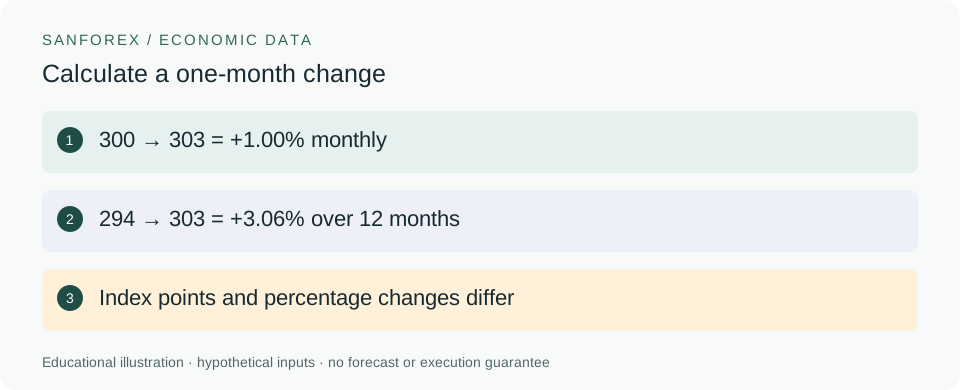
Hypothetical example: 300 → 303 = +1.00% monthly. 294 → 303 = +3.06% over 12 months. Index points and percentage changes differ.
Open full-size diagram ↗Use the correct comparison month for an annual change
If the comparable index was 294.0 in the same month a year earlier, the 12-month change to 303.0 is (303.0 ÷ 294.0 − 1) × 100 ≈ 3.06%. This is a different comparison from the 1% monthly change above. It is also different from comparing the average of twelve monthly index levels in one calendar year with the average in another. Write the exact starting and ending periods beside the number rather than using the ambiguous label annual inflation.
Do not add monthly percentage changes mechanically
For an original two-month example, start at 100, rise by 1% to 101, then rise another 1% to 102.01. The cumulative increase is 2.01%, because the second increase uses a different base. Likewise, extrapolating one unusually large month into a year is a hypothetical assumption, not a measured annual change. Do not combine a seasonally adjusted monthly series with an unadjusted level from another series just because the labels look similar.
Keep economic interpretation separate from a trading claim
A broad price index is not a personal household budget and does not mechanically determine a currency’s next move. When reading a release, retain the source link, reference month, publication time, units and whether any earlier values were revised. Compare like with like before discussing a change. SanForex’s currency converter measures exchange-rate arithmetic, not inflation-adjusted purchasing power. It cannot turn a CPI headline into an investment signal, and the examples here should not be used as one.
Sources and conventions
Examples are hypothetical. Worked examples state their formulas and assumptions in the article; our methodology explains the related calculators. Broker contract specifications determine actual lot, margin and execution conditions. These sources document definitions and data; a source link does not imply endorsement of SanForex or a trading service.
These materials are prepared with AI assistance and checked against worked examples and deterministic calculation tests where applicable. They are not an expert suitability assessment or investment advice.
Open currency converter tool ↗