How to choose a free vs paid trading journal: a test checklist
Compare storage, import limits, exports and subscription terms using a small repeatable journal test—not promises of trading returns.
Choose the job before choosing a subscription
A trading journal can be a spreadsheet, a local browser tool or a hosted service. Start with the recurring task: recording a few closed trades, importing many executions, comparing setups or keeping several devices synchronized. These are different requirements. A low price is not useful if the workflow loses the records or fields you need; an extensive feature list is not useful if you will not use it. This is a selection checklist, not a ranking of trading performance or a claim that software makes a strategy profitable.
Separate our tests from vendor descriptions
We build the SanForex journal and check its arithmetic and backup behavior with synthetic examples and automated tests. The hosted-product facts below come from the vendors' public documentation checked on November 2, 2026. We have not completed hands-on comparative testing of their paid plans. These source links are not commission-bearing links, and no placement on this page was purchased. Prices, limits and billing conditions can change; verify them in the exact plan and checkout shown to you.
Free plan, free trial and paid access are different
TraderSync describes a continuing Basic plan with 30 file-imported executions per calendar month and unlimited manual entry. Its separate trial documentation says trade and execution exports are unavailable during the trial. An execution allowance is not necessarily a closed-trade allowance: partial fills may consume several executions. Tradervue's pricing page says a trial can automatically become paid unless you switch to a free plan before it ends. Read the terms of the actual signup route; do not treat the word free as a promise of unlimited importing, exporting or access.
Use five invented trades as an acceptance test
Create five closed net results in one currency: +150, −100, +75, −50 and 0. Their total is +75; average net per record is 15. If zero-net records are excluded from win rate, there are two wins and two losses, so the result is 50%. Positive results total 225 and absolute negative results total 150, giving a profit factor of 1.50. In the stated order, cumulative results are 150, 50, 125, 75 and 75; the largest peak-to-trough closed-trade decline is 100. These are checks on this tiny invented dataset, not forecasts or evidence of a trading edge.
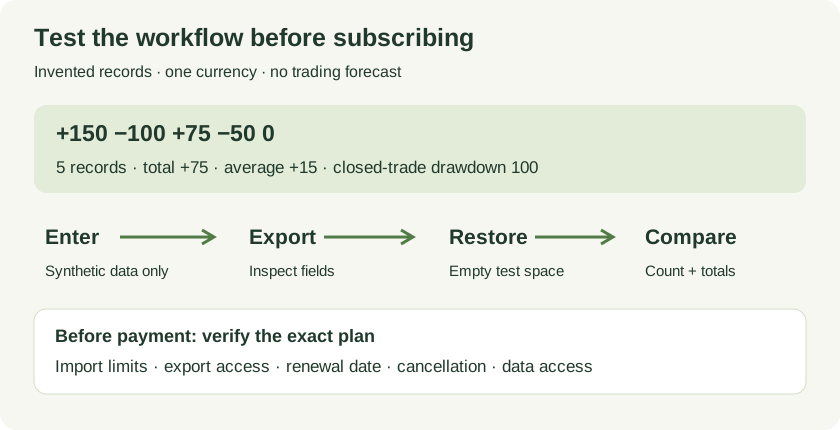
Five invented net results of +150, −100, +75, −50 and 0 total +75. Compare record count, currency and totals after export and restore, then check subscription and access terms.
Open full-size diagram ↗Check what happens when you leave
Export the test records and inspect dates, currency, costs and notes. If import is supported, restore into an empty test workspace and compare the record count and totals. If the trial blocks export, record that limitation rather than assuming the paid output will contain every field. Edgewonk says you can cancel at the end of a subscription period and that cancelled customers lose login access; verify the exact cutoff in the checkout terms. Export availability, access after cancellation and a refund are separate questions. Check retention and deletion terms before uploading personal trading records.
Know the trade-offs of local storage
SanForex's free journal keeps entries in this browser's local storage and supports JSON backup and restore; it is not a cloud synchronization service. Clearing site data, losing a device or using another browser can make the saved local copy unavailable. Keep your own export and test a restore. A spreadsheet allows custom columns but requires you to maintain formulas and backups. A hosted service may offer integrations or multi-device workflows, but requires evaluating account access, ongoing cost and the provider's data handling. Confirm a feature in the specific plan rather than assuming all hosted journals have it.
Write down a pass or fail for the workflow
Before paying, record: supported source format; manual versus automated entry; how partial fills count; whether fees and currency are preserved; required charts or tags; export contents; restore result; renewal date; and how cancellation works. Test only with invented data until you understand the service. If a free workflow passes all requirements, a paid upgrade has no demonstrated benefit for those requirements. If it fails a necessary task, compare the exact paid feature and its total billed cost. Avoid assigning a monetary value to promised improvements in trading results.
Next step: run the baseline and keep the evidence
Use the linked free journal to reproduce the five-record baseline, then keep a backup and your checklist when evaluating another tool. Differences in win-rate denominators, fee treatment and ordering can explain apparently conflicting metrics. Resolve those definitions before relying on a comparison. The decision is about data handling and workflow fit; it does not establish that any journal, broker or trading method is suitable for your financial situation.
Sources and conventions
Examples are hypothetical. Arithmetic follows the formulas documented in our methodology. Broker contract specifications determine actual lot, margin and execution conditions. These sources document definitions and data; a source link does not imply endorsement of SanForex or a trading service.
- TraderSync: Basic free plan and import allowance (checked November 2, 2026) ↗
- TraderSync: trial export restrictions ↗
- Tradervue: plan comparison and trial billing terms ↗
- Edgewonk: subscription features and cancellation FAQ ↗
- SanForex calculation and journal conventions ↗
These materials are prepared with AI assistance and checked against worked examples and deterministic calculation tests where applicable. They are not an expert suitability assessment or investment advice.
Open trading journal tool ↗