Average trade return: equal trades or equal invested amounts?
An average of trade percentages gives each selected trade equal weight unless another convention is specified.
Define the weighting before averaging
An average of trade percentages gives each selected trade equal weight unless another convention is specified. A return on combined invested amounts weights results by those amounts. These can differ sharply when trade sizes differ. Neither should be called an account return without considering timing, cash flows and overlapping exposure.
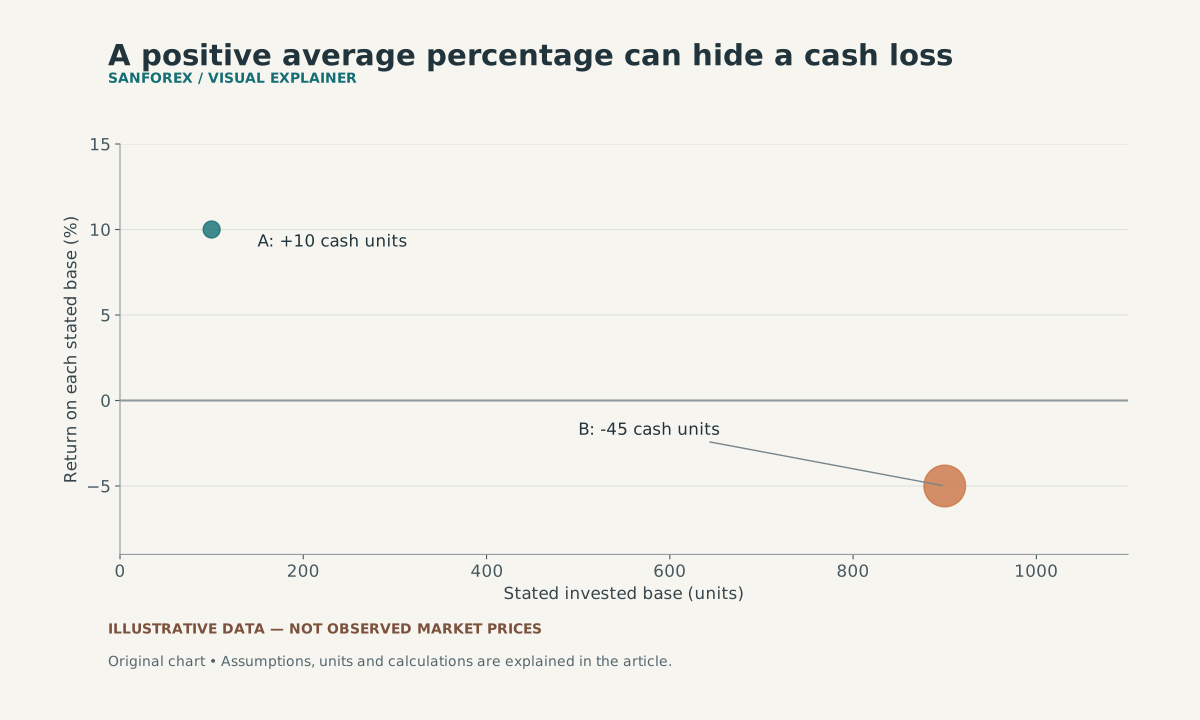
Trade A gains 10% on 100 units while B loses 5% on 900 units. Marker size reflects the base. Equal-trade mean return is positive, but combined cash result is minus 35.
Open full-size diagram ↗Compare two hypothetical observations
Trade A uses 100 units and earns 10, a 10% return on its stated base. Trade B uses 900 units and loses 45, a −5% return. The equal-trade average is (10% − 5%) ÷ 2 = 2.5%. Total profit is −35 on a combined base of 1,000, or −3.5%. The positive equal-trade average does not contradict the negative cash result; it summarizes a different weighting.
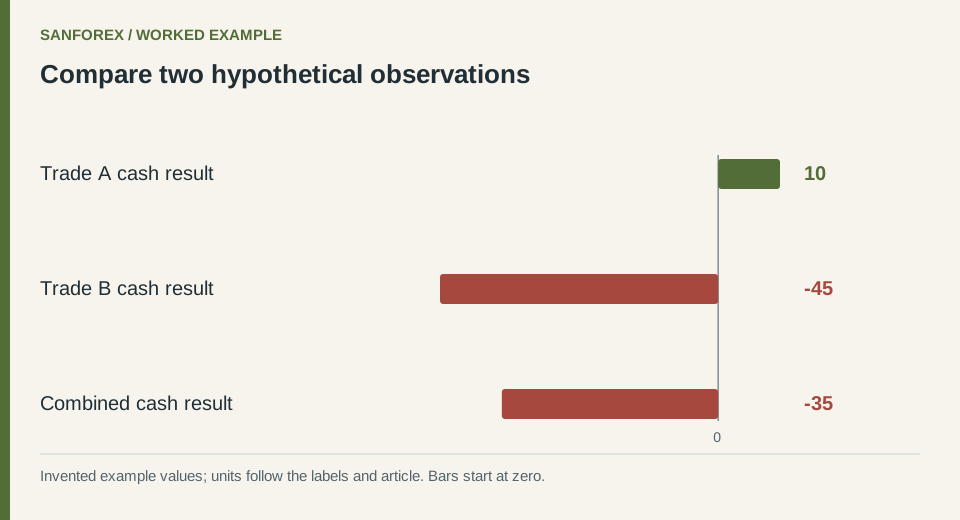
Worked example: Trade A cash result: 10; Trade B cash result: -45; Combined cash result: -35. Invented values; units follow the row labels and article.
Open full-size diagram ↗Check what the denominator represents
For leveraged instruments, margin, notional and a risk budget are different possible bases. A return calculated using margin is not interchangeable with one using total account equity. Label the base for each row and reject comparisons that mix definitions. Summing reused capital across sequential trades also does not produce a clean account-return denominator.
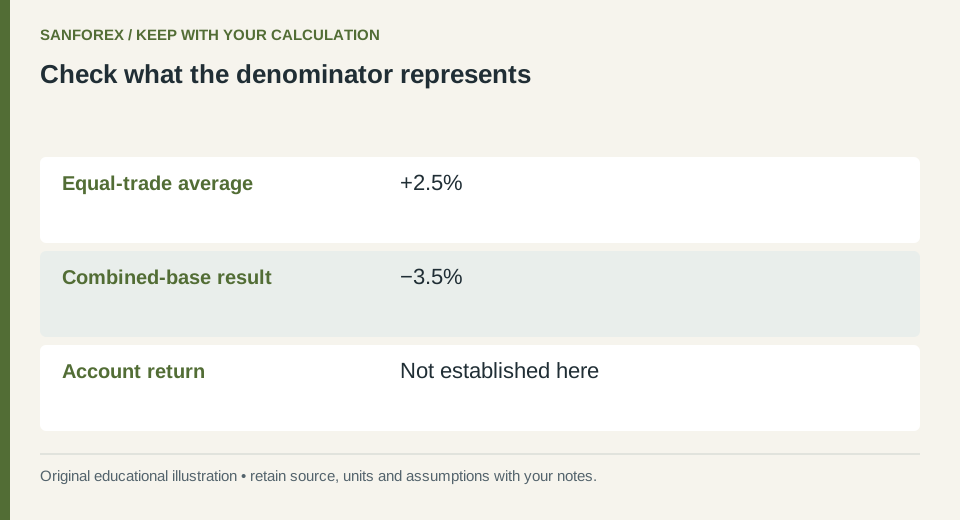
Calculation checklist: Equal-trade average: +2.5%; Combined-base result: −3.5%; Account return: Not established here. Preserve these definitions when reproducing the example.
Open full-size diagram ↗Keep the useful journal measures separate
Report total net cash result, trade count, per-trade average cash outcome and any percentage measure under explicit labels. SanForex’s local journal reports cash-result statistics, not a verified time-weighted or money-weighted account return. Preserve the source amounts so another reader can reproduce the weighting choice.
Sources and conventions
Examples are hypothetical. Worked examples state their formulas and assumptions in the article; our methodology explains the related calculators. Broker contract specifications determine actual lot, margin and execution conditions. These sources document definitions and data; a source link does not imply endorsement of SanForex or a trading service.
These materials are prepared with AI assistance and checked against worked examples and deterministic calculation tests where applicable. They are not an expert suitability assessment or investment advice.
Open trading journal tool ↗