Bond coupon versus current yield: the price denominator matters
Bond coupon versus current yield: the price denominator matters. An illustrated, hypothetical worked example with assumptions and source checks.
Identify the denominator before comparing percentages
Coupon rate relates annual coupon cash to face value. Current yield relates annual coupon cash to the bond's market price. The Investor.gov definition supports that distinction. A price denominator can change while the coupon cash stays the same, so write down which price basis and cash period each percentage uses. If coupons are paid in installments, account for the schedule before calling their sum annual coupon cash.
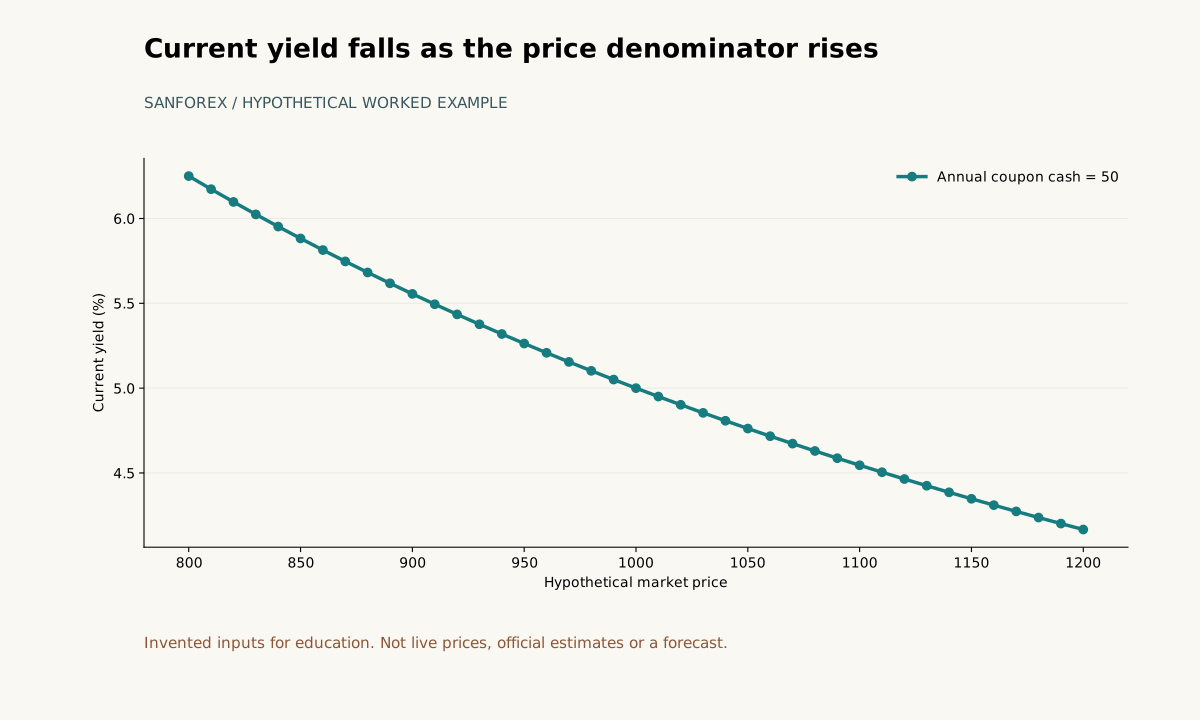
Annual coupon cash fixed at 50; prices 900, 1000 and 1100 imply 5.5556%, 5% and 4.5455%.
Open full-size diagram ↗A hypothetical worked example
A hypothetical fixed-coupon bond has face value 1000 and annual coupon cash of 50. Its coupon rate is 5%. At market prices of 900, 1000 and 1100, current yields are about 5.5556%, 5% and 4.5455%. The annual coupon cash is unchanged in all three scenarios. These current yields omit maturity repayment, reinvestment, default, taxes and transaction costs; they are not yield-to-maturity calculations.
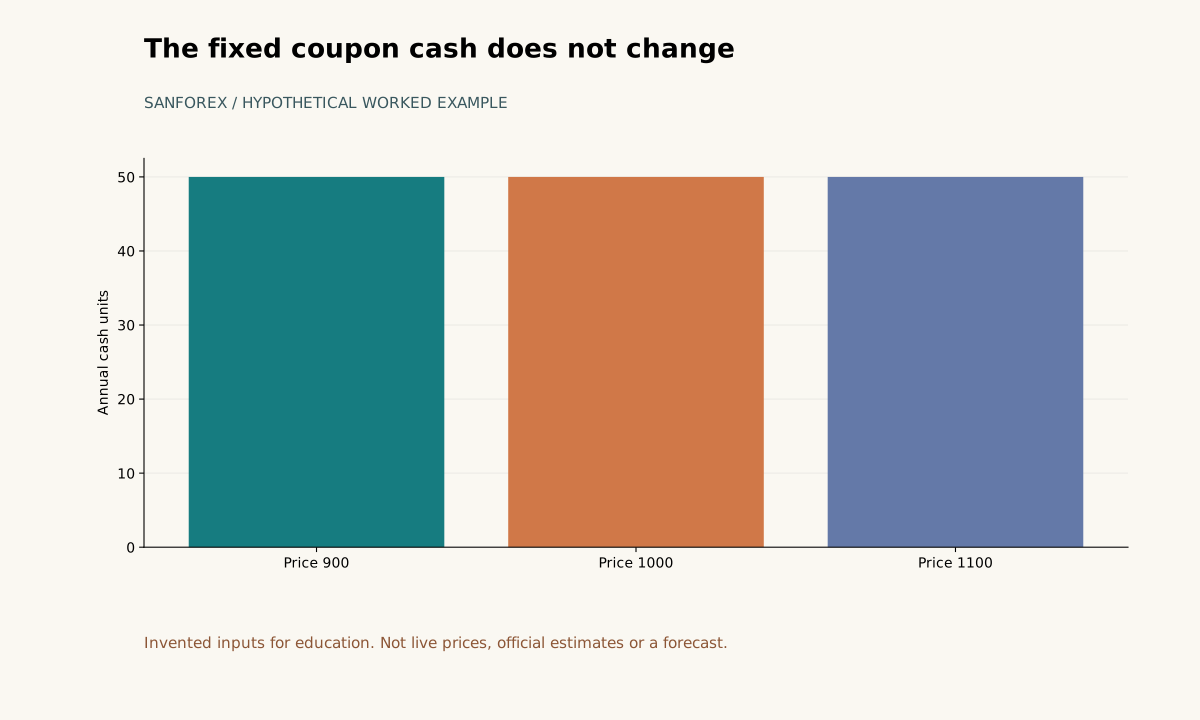
Coupon cash is 50 under each invented market price. Face value is 1000; coupon rate is 5%.
Open full-size diagram ↗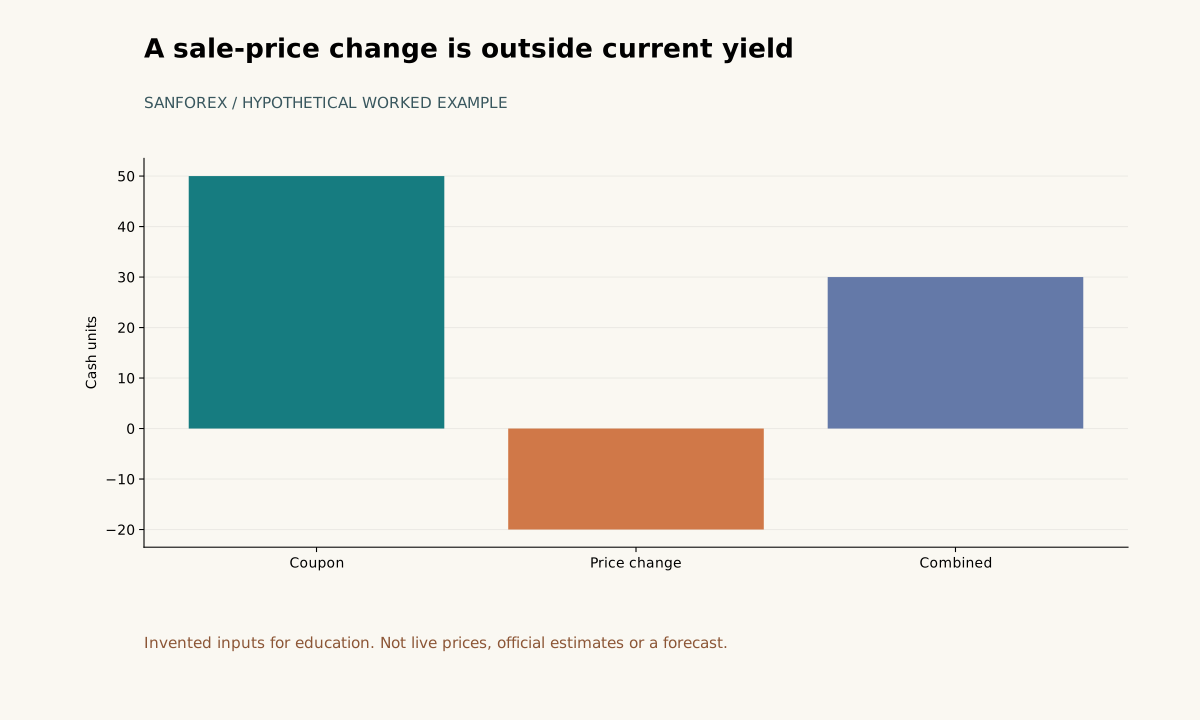
Separate one-year scenario: buy 900, coupon 50, sell 880; net 30 before costs, or 3.3333%.
Open full-size diagram ↗Reproduce the arithmetic
For each price, calculate annual coupon cash divided by market price, then multiply by 100 to express a percentage: 50 / 900 × 100 = 5.555556%; 50 / 1000 × 100 = 5.000000%; 50 / 1100 × 100 = 4.545455%. Rounded to four decimal places, these match the figures above. This is a direct arithmetic demonstration; the SanForex currency converter displays currency conversions and does not calculate bond current yield.
Read the comparison carefully
With annual coupon cash held fixed, a higher market-price denominator produces a lower current yield. This relationship describes the arithmetic of the hypothetical inputs; it does not say that an actual bond will trade at any of those prices. Coupon rate and current yield answer different questions because they divide the same annual cash amount by different values: face value and market price, respectively.
Keep the measure and assumptions visible
Current yield does not include repayment at maturity, reinvestment of coupon payments, default, taxes or transaction costs. It is not total return and is not yield to maturity. Actual bond quotations and settlement can involve conventions or accrued interest that this simple example does not model. Use the bond's terms and a method that explicitly models timed cash flows when a different measure is needed.
A careful comparison worksheet
Record annual coupon cash, face value, market price, the date and price convention, and the measure being compared. Compare current yield with current yield, and label coupon rate separately. This guide uses no live bond quote and does not rank bonds, assess issuer credit or make an investment recommendation. The related currency converter is for currency conversion; its displayed result is not a bond-yield result.
Sources and conventions
Examples are hypothetical. Worked examples state their formulas and assumptions in the article; our methodology explains the related calculators. Broker contract specifications determine actual lot, margin and execution conditions. These sources document definitions and data; a source link does not imply endorsement of SanForex or a trading service.
These materials are prepared with AI assistance and checked against worked examples and deterministic calculation tests where applicable. They are not an expert suitability assessment or investment advice.
Open currency converter tool ↗