Labor productivity: output growth and hours growth are different
A hypothetical worked example shows how output per hour changes when output and labor hours grow at different rates.
Start with both inputs
Labor productivity compares output with labor hours. Output can rise because more hours are worked, because more is produced per hour, or through both. The supplied BLS evidence distinguishes labor productivity from total factor productivity, which covers a broader combination of inputs. Treat the measure as output per hour, not as an individual worker score. Identify the output measure, hours coverage, sector and comparison period when interpreting a published estimate.
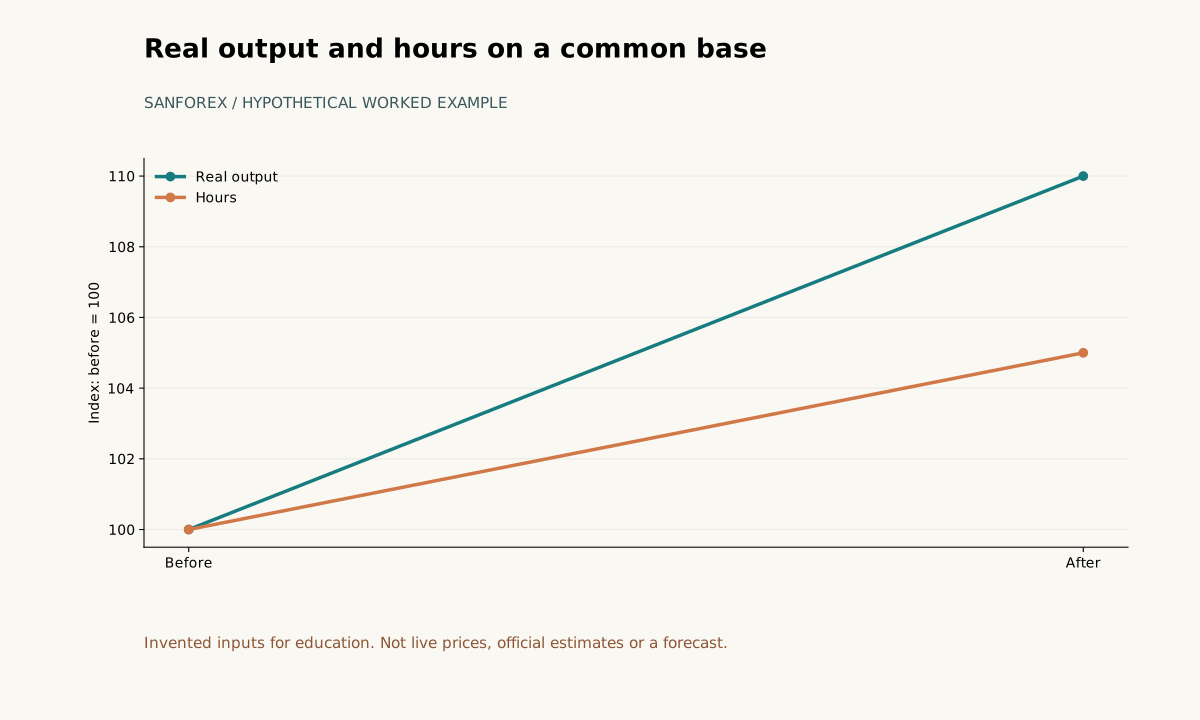
Real output index 110.00; hours index 105.00. Original invented inputs.
Open full-size diagram ↗A hypothetical worked example
In a hypothetical same-base index example, output rises from 100 to 110 while hours rise from 100 to 105. Output per hour rises from 100 to 104.7619: (110 / 105) x 100. Productivity growth is about 4.76%, not the 10% growth in output and not exactly the 5 percentage-point subtraction. These are period-to-period changes, not annualized rates.
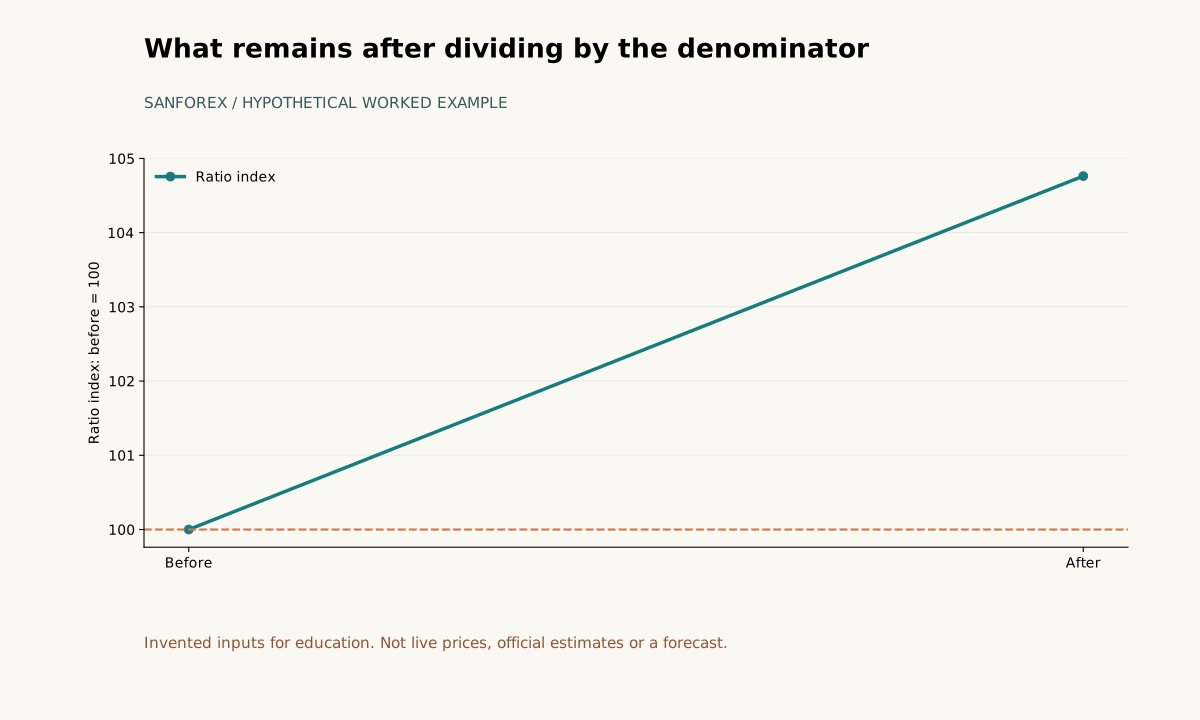
Ratio index moves from 100 to 104.7619, a change of 4.7619%.
Open full-size diagram ↗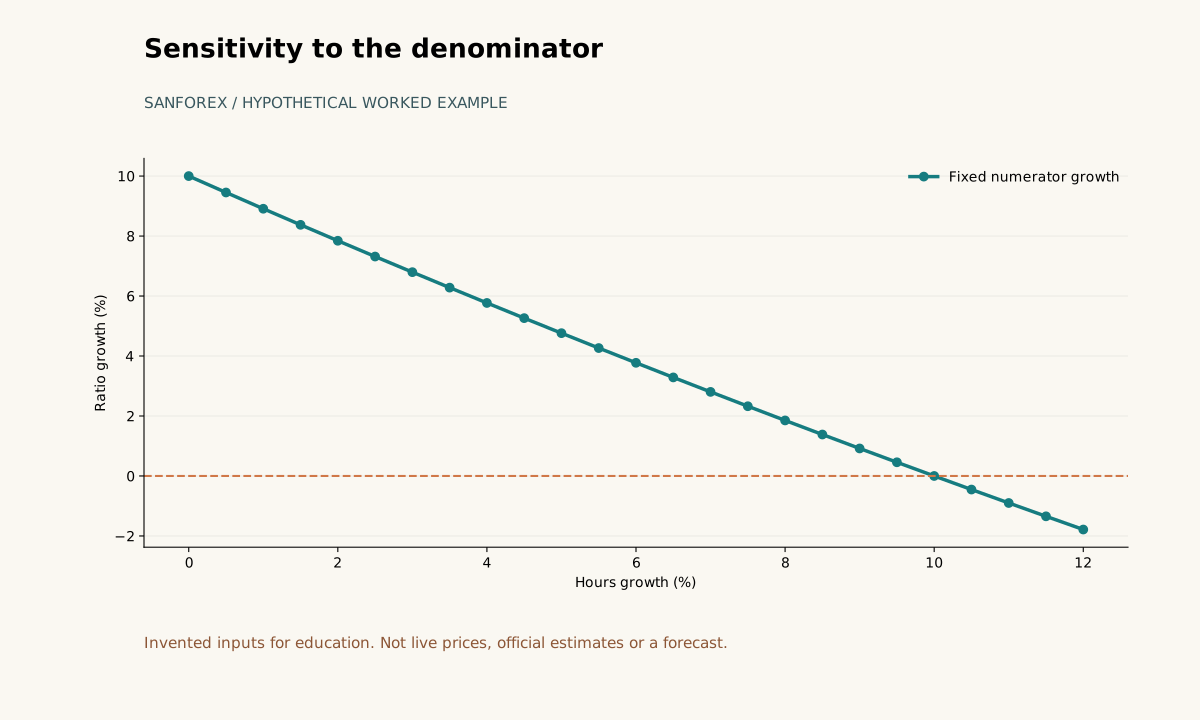
Numerator growth held at 10.00%; denominator growth varies from 0% to 12%. Scenarios, not forecasts.
Open full-size diagram ↗Calculate the ratio
For indexes sharing the same starting value, divide the output index by the hours index and multiply by 100. Here, (110 / 105) x 100 = 104.7619, so the index rises about 4.76% from its base of 100. The exact growth relationship is (1 + output growth) / (1 + hours growth) - 1. Subtracting growth rates is only an approximation; keep unrounded inputs until the final display.
Keep index level and growth separate
The resulting index level is about 104.76; its change from the base is about 4.76%. Those numbers answer different questions. The arithmetic describes output per hour for the stated inputs. It does not by itself establish why productivity changed or attribute the change to technology, management or policy.
Compare like periods and revisions
The supplied BLS evidence says productivity estimates can be revised. When working from published series, note the release or data vintage and use output and hours from compatible periods. This example compares two periods directly and is not annualized. Do not compare its period-to-period change with an annualized rate as though they used the same time basis.
Know what the related tool calculates
The SanForex currency converter converts a currency amount using reference or user-entered exchange rates. It does not calculate labor productivity or accept output and hours indexes. Reproduce this example with the ratio shown above; the converter is not part of that calculation. Its displayed result is a converted reference amount, not an economic statistic.
Sources and conventions
Examples are hypothetical. Worked examples state their formulas and assumptions in the article; our methodology explains the related calculators. Broker contract specifications determine actual lot, margin and execution conditions. These sources document definitions and data; a source link does not imply endorsement of SanForex or a trading service.
These materials are prepared with AI assistance and checked against worked examples and deterministic calculation tests where applicable. They are not an expert suitability assessment or investment advice.
Open currency converter tool ↗