Market, limit and stop orders: price control versus execution
Understand which instruction controls price, which triggers an order, and why a stop price is not a guaranteed fill.
Separate the instruction from the outcome
An order tells a venue or provider what to attempt; it is not a completed trade. Investor.gov distinguishes market, limit and stop orders for stocks. A market order prioritizes buying or selling at available market prices rather than a specified price. A limit order sets a price boundary but may not execute. A stop order becomes a market order after its trigger is reached under the applicable rules. These definitions are a starting point, not a guarantee that an FX or CFD provider uses identical trigger and execution policies.
Compare two hypothetical buy instructions
Imagine an instrument showing offers near 50.00. A buy limit at 49.50 sets the highest acceptable execution price, but the market may never reach it. A market buy seeks execution using available offers and might fill at 50.00, 50.03, or multiple prices, depending on conditions and quantity. Neither choice is universally better. The practical question is whether the instruction expresses your intended price constraint, and whether you understand the consequences if there is no fill.
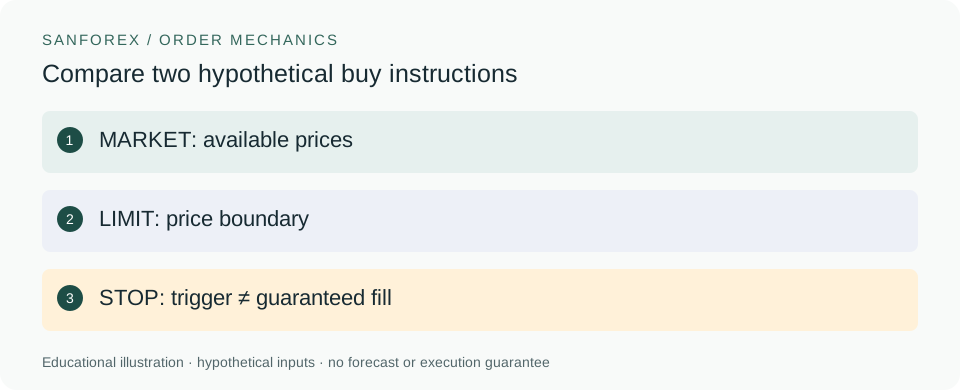
Hypothetical example: MARKET: available prices. LIMIT: price boundary. STOP: trigger ≠ guaranteed fill.
Open full-size diagram ↗A trigger price does not cap the loss
Consider a hypothetical long position of 100 units bought at 50.00, with a stop trigger at 48.00. A simple planning estimate is (50 − 48) × 100 = 200 currency units of price loss. If the triggered order instead fills at 47.50, the price loss is 250 before fees. This difference is why a position-sizing calculation using a stop distance cannot establish a guaranteed maximum loss. The numbers are a mechanics example, not a recommended entry or stop.
Understand the stop-limit trade-off
A stop-limit instruction combines a trigger with a limit order rather than an unrestricted market order. For example, a sell stop-limit with a trigger of 48.00 and limit of 47.80 might remain unfilled if available bids move below 47.80. Price protection and certainty of execution are different properties. Check whether the provider offers this instruction, which price stream triggers it, and how gaps or partial fills are handled. Never assume that adding a limit removes risk.
Review the actual order ticket
Before interpreting a result, record the instrument, side, quantity, order type, trigger, limit, time-in-force and any expiry. Distinguish an accepted order from an executed one, and cancellation requested from cancellation confirmed. If a platform offers guaranteed stops or other special protections, read the actual eligibility, charges and terms rather than assuming the basic order definition includes them. SanForex calculates hypothetical quantities and price distances; it does not submit orders or model your provider’s execution engine.
Sources and conventions
Examples are hypothetical. Worked examples state their formulas and assumptions in the article; our methodology explains the related calculators. Broker contract specifications determine actual lot, margin and execution conditions. These sources document definitions and data; a source link does not imply endorsement of SanForex or a trading service.
These materials are prepared with AI assistance and checked against worked examples and deterministic calculation tests where applicable. They are not an expert suitability assessment or investment advice.
Open position size tool ↗