Real wage growth: why a pay rise can lose purchasing power
A hypothetical, reproducible comparison shows how pay and a matching price index combine to change purchasing power, with limits for series and units.
Match earnings with a price index
A real-pay comparison adjusts nominal earnings using a price index. The Bureau of Labor Statistics (BLS) uses CPI-U to deflate all-employee earnings and CPI-W for production and nonsupervisory earnings. Choose the earnings and deflator series that belong together, and keep the population and period clear. A published average is an aggregate measure, not a description of every worker's pay or personal cost of living.
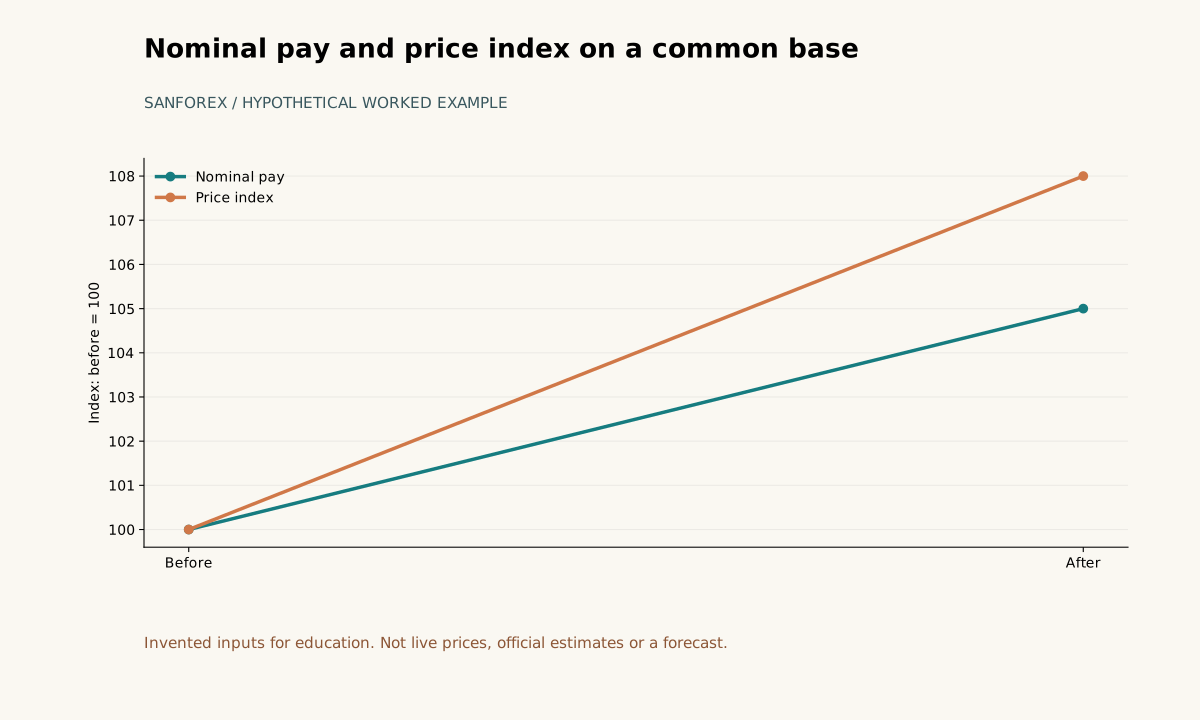
Nominal pay index 105.00; price index index 108.00. Original invented inputs.
Open full-size diagram ↗A hypothetical worked example
In a hypothetical hourly-pay comparison, pay rises from 20.00 to 21.00 while the matching price index rises from 100 to 108. Nominal pay grows 5%. New pay in the original period’s purchasing-power units is 21 / 1.08 = 19.4444. The real change is (21 / 20) / (108 / 100) - 1 = -2.7778%, or about -2.78%. Taxes, hours worked and personal spending differences are outside this example.
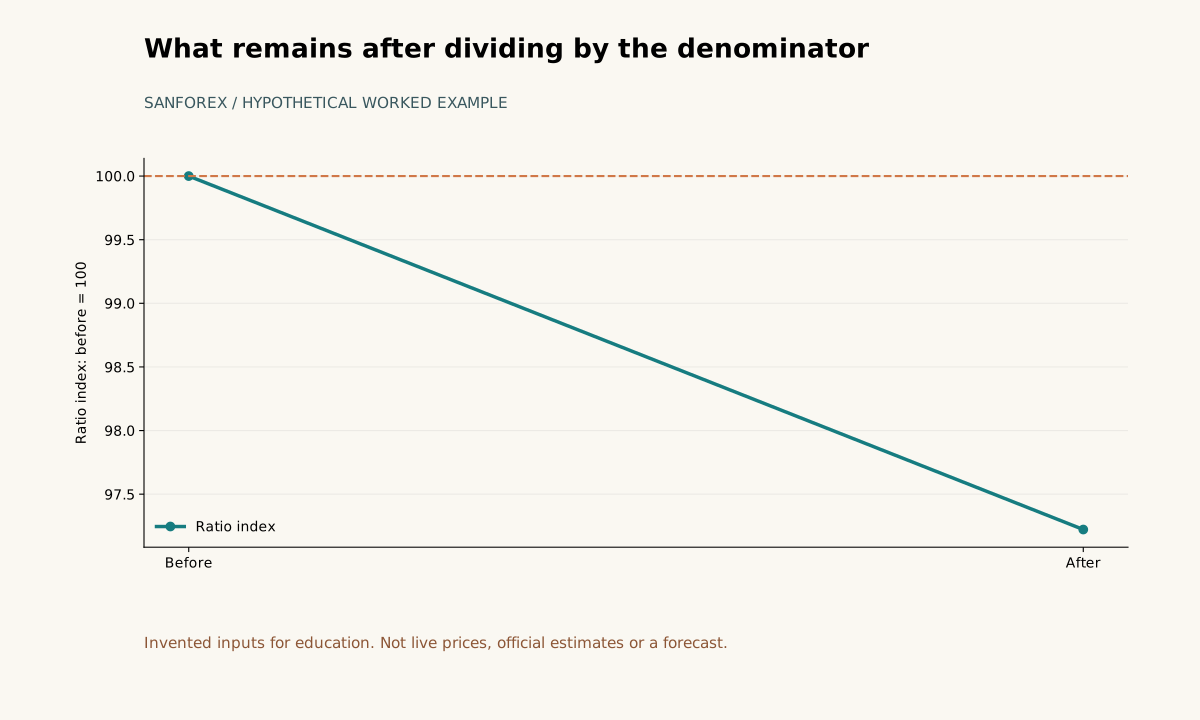
Ratio index moves from 100 to 97.2222, a change of -2.7778%.
Open full-size diagram ↗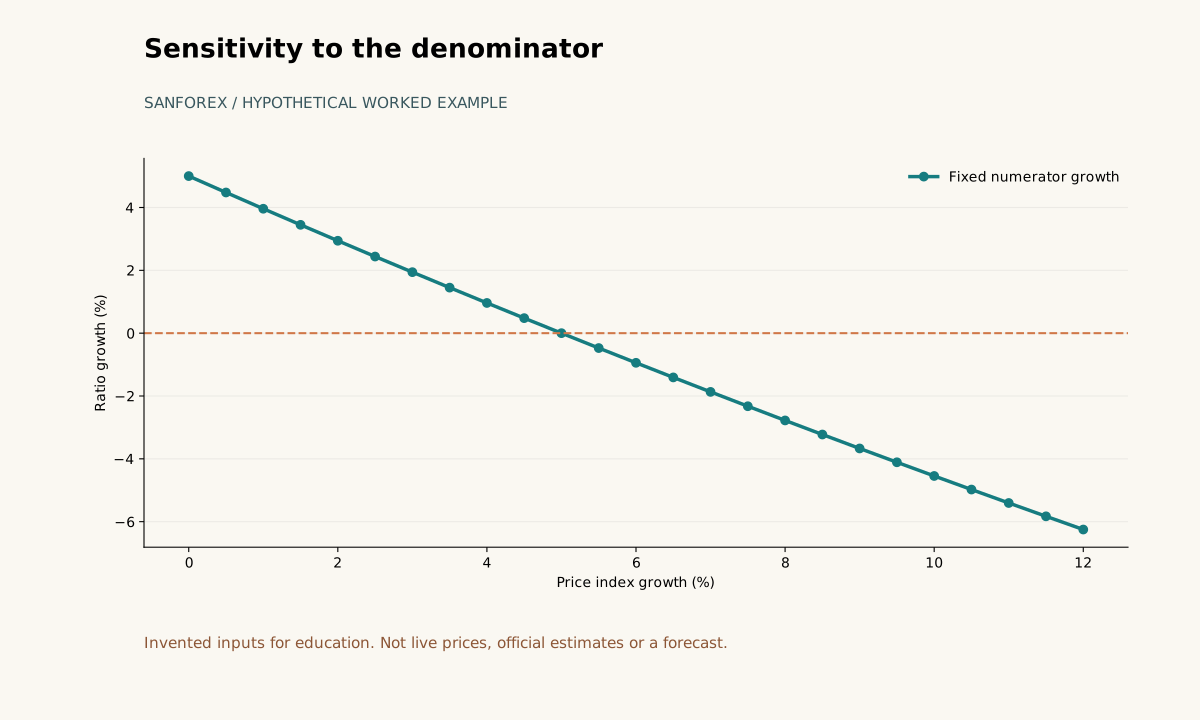
Numerator growth held at 5.00%; denominator growth varies from 0% to 12%. Scenarios, not forecasts.
Open full-size diagram ↗Check the ratio and units
Divide the later index by the earlier index to get the price factor: 108 / 100 = 1.08. Divide later pay by that factor to express it in earlier-period purchasing-power units, then compare with earlier pay. Equivalently, real growth is (later pay / earlier pay) / (later index / earlier index) - 1. Subtracting 8% from 5% gives -3 percentage points as an approximation; the ratio calculation gives about -2.78%. Match the periods and keep hourly pay separate from weekly pay.
Separate the tool display from the example
The SanForex currency converter displays a converted currency reference amount from an amount, selected currencies and reference or user-supplied exchange rates. It does not calculate wage growth, inflation adjustment or a real-pay result. Reproduce this guide’s hypothetical result with the ratios shown here. If using the converter for a separate currency conversion, interpret its displayed converted amount and rate details only as currency-conversion output.
Keep hours and workforce mix in view
Hourly pay does not by itself describe weekly earnings: weekly pay also depends on hours worked. Keep the pay measure and its unit explicit when comparing periods. BLS notes that average earnings can also change when the composition of employment changes, so movement in an aggregate average does not mean each worker received the same raise. The calculation here does not account for taxes, benefits, hours changes or individual spending patterns.
Record inputs and scope
For a published-series comparison, note the earnings measure, matching price index, units, reference periods and data release or vintage used. Retain full-precision inputs through the calculation and round the final result for display. This is an educational method with hypothetical numbers, not a live earnings series, a personal cost-of-living estimate or a salary forecast.
Sources and conventions
Examples are hypothetical. Worked examples state their formulas and assumptions in the article; our methodology explains the related calculators. Broker contract specifications determine actual lot, margin and execution conditions. These sources document definitions and data; a source link does not imply endorsement of SanForex or a trading service.
These materials are prepared with AI assistance and checked against worked examples and deterministic calculation tests where applicable. They are not an expert suitability assessment or investment advice.
Open currency converter tool ↗