Compare money-transfer quotes by what the recipient receives
Compare two hypothetical transfer offers using the same sender budget, fee placement and destination currency.
Set the comparison question before choosing a rate
A higher advertised exchange rate does not settle which quote delivers more money. Choose a fixed sender budget or a fixed recipient amount, then use that same basis for every offer. The CFPB’s US remittance materials distinguish transfer amounts, exchange rates, fees and the amount received. Those materials provide a useful vocabulary; they do not establish that a particular legal disclosure rule applies to every country or transfer. This article compares invented arithmetic, not providers.
Compare two hypothetical fixed-budget offers
Suppose the total sender budget is 1,000 USD and the recipient wants EUR. Offer A deducts a 5 USD fee from that budget and converts the remaining 995 USD at 0.9200 EUR per USD. The recipient amount is 915.40 EUR. Offer B deducts a 1 USD fee and converts 999 USD at 0.9160 EUR per USD, producing 915.084 EUR, or 915.08 EUR if rounded once to cents at the end. Under these exact assumptions A delivers 0.32 EUR more despite its higher visible fee.
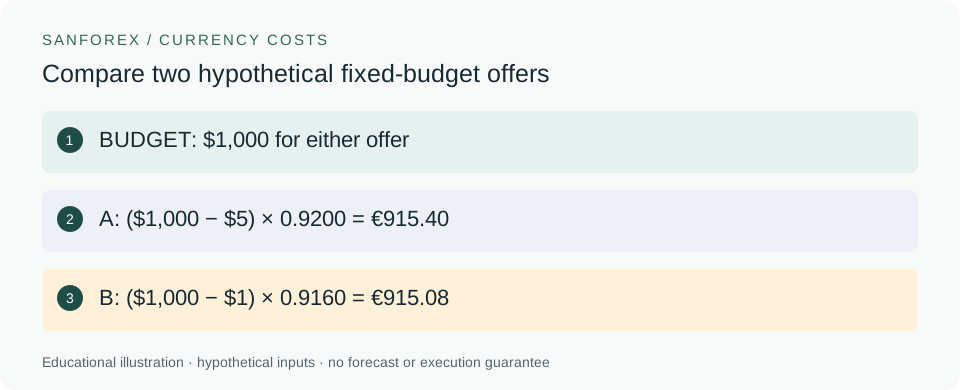
Hypothetical example: BUDGET: $1,000 for either offer. A: ($1,000 − $5) × 0.9200 = €915.40. B: ($1,000 − $1) × 0.9160 = €915.08.
Open full-size diagram ↗Ask where every fee is charged
The example changes if a fee is paid on top of the stated sending amount rather than deducted from it. Comparing 1,000 USD converted by one offer with a 1,000 USD total budget at another is not like-for-like. Destination deductions can also change the comparison: if A’s example incurs an additional 3 EUR deduction, its recipient amount becomes 912.40 EUR. Do not assume an unknown deduction is zero. Record an unavailable value as unknown and request a quote that explains it.
Use a reference conversion only as a separate benchmark
SanForex’s converter can calculate an amount using a dated reference rate or a supplied custom rate. It does not retrieve provider offers, deduct remittance fees or guarantee delivery. For the worksheet above, calculate the amount eligible for conversion separately, then enter the quote’s rate with the correct units. Keep the quote timestamp, payment method, destination currency and rate expiry alongside the result. A reference-rate difference alone does not identify which part is a fee or guarantee a realizable saving.
Compare the non-price terms on the same worksheet
Record delivery estimate, funding method, recipient details required, quote expiry and any stated third-party deductions. Offers collected at different times or using different funding methods may not be comparable. If one offer does not specify an amount received, flag that uncertainty rather than naming a winner. The useful output is a transparent comparison of disclosed amounts and assumptions, not a universal ranking of transfer services or a recommendation to transact.
Sources and conventions
Examples are hypothetical. Worked examples state their formulas and assumptions in the article; our methodology explains the related calculators. Broker contract specifications determine actual lot, margin and execution conditions. These sources document definitions and data; a source link does not imply endorsement of SanForex or a trading service.
These materials are prepared with AI assistance and checked against worked examples and deterministic calculation tests where applicable. They are not an expert suitability assessment or investment advice.
Open currency converter tool ↗