Exchange-rate markup percentages depend on the denominator
A percentage difference between two exchange rates needs a specified quote direction and denominator.
Define the comparison before naming a markup
A percentage difference between two exchange rates needs a specified quote direction and denominator. A difference calculated relative to a reference rate is not necessarily the same percentage as a shortfall calculated relative to the offered rate. Neither figure automatically identifies a separately charged fee. State exactly what is being compared.
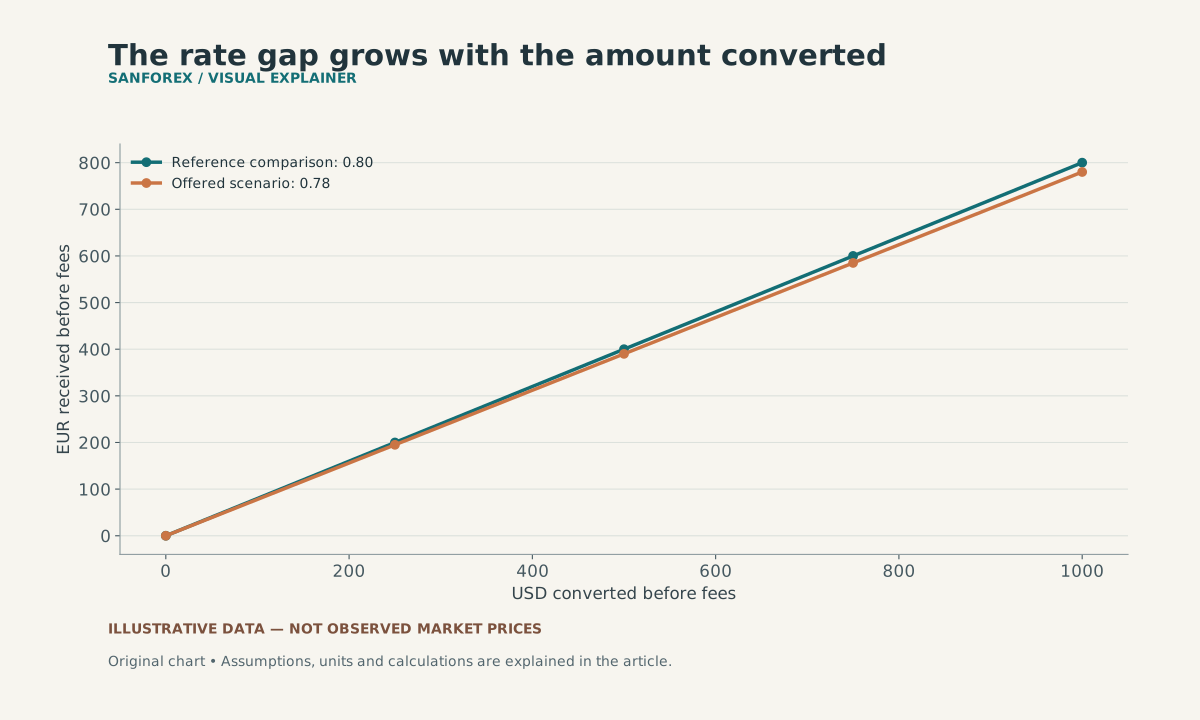
At hypothetical rates of 0.80 and 0.78 EUR per USD, 1,000 USD implies 800 versus 780 EUR. The 20 EUR gap excludes separate charges and is not itself an itemized fee.
Open full-size diagram ↗Calculate two legitimate percentages
Assume a reference comparison of 0.80 EUR per USD and an offered rate of 0.78 EUR per USD. Relative to the reference, the shortfall is (0.80 − 0.78) ÷ 0.80 = 2.5%. Relative to the offer, the difference is 0.02 ÷ 0.78 ≈ 2.5641%. For 1,000 USD before any separate charge, those rates imply 800 EUR and 780 EUR, a 20 EUR difference. The percentage labels must explain their different bases.
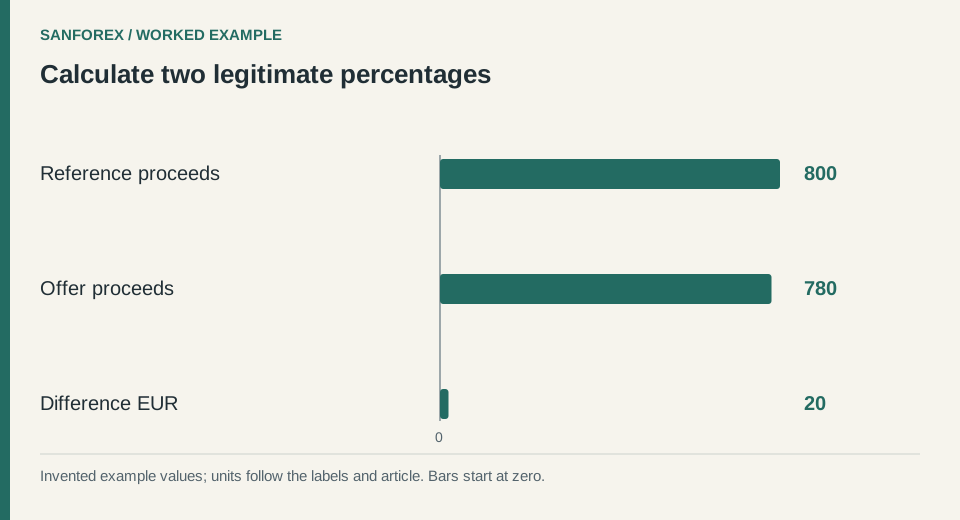
Worked example: Reference proceeds: 800; Offer proceeds: 780; Difference EUR: 20. Invented values; units follow the row labels and article.
Open full-size diagram ↗Do not confuse the rate difference with total transaction cost
If a sender also pays a fixed charge, include it on the correct side of the conversion. The CFPB’s disclosure terminology separates rates, transfer amounts and fees; this article is not a statement of legal coverage. A rate-only comparison omits those other items. Comparing recipient amounts under the same total sender budget answers a different, often more practical question.
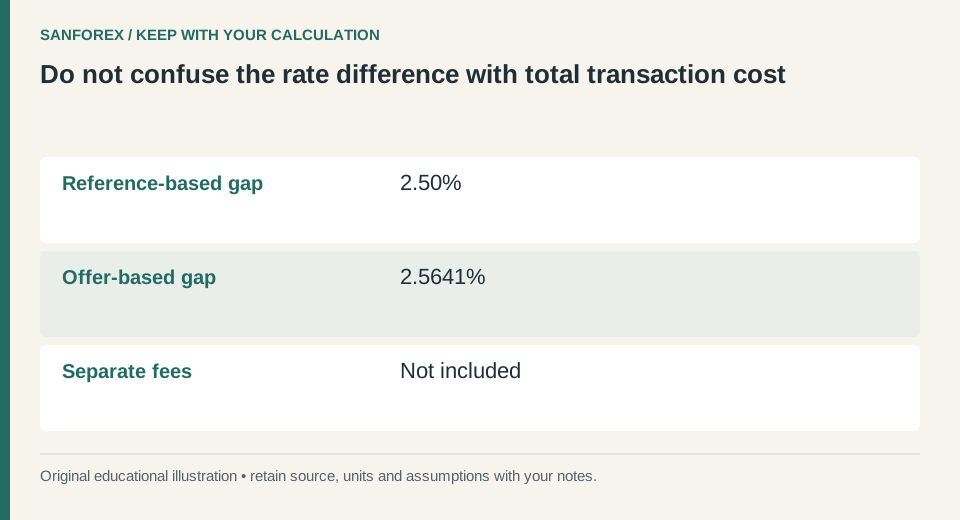
Calculation checklist: Reference-based gap: 2.50%; Offer-based gap: 2.5641%; Separate fees: Not included. Preserve these definitions when reproducing the example.
Open full-size diagram ↗Keep a reproducible comparison record
Save both rates, units, timestamps, amount and fee treatment. Calculate with unrounded rates where possible and round the final displayed result according to your stated convention. Inverting the rates changes the percentage expression, so do not copy a percentage across quote directions. The currency converter can check scenario amounts, but it does not audit a provider’s pricing policy or identify an undisclosed charge.
Sources and conventions
Examples are hypothetical. Worked examples state their formulas and assumptions in the article; our methodology explains the related calculators. Broker contract specifications determine actual lot, margin and execution conditions. These sources document definitions and data; a source link does not imply endorsement of SanForex or a trading service.
These materials are prepared with AI assistance and checked against worked examples and deterministic calculation tests where applicable. They are not an expert suitability assessment or investment advice.
Open currency converter tool ↗