Read an economic calendar: release time, reference period and revisions
Build a reliable release note by separating publication time, the period measured and revisions to earlier observations.
Treat a calendar entry as a publication appointment
An economic calendar tells you when information is scheduled to be released. The month or quarter measured by that information can be earlier than the publication date. For example, a report released in November might describe October; always use the reference period stated by the issuing agency. The BLS maintains an official Employment Situation release schedule. Consult the current schedule rather than assuming a report always arrives on a particular weekday. This page is a reading workflow, not a live calendar.
Record the time zone explicitly
A displayed time without a zone is incomplete. Suppose a hypothetical release is scheduled for 08:30 in New York. When the applicable offset is UTC−5, that is 13:30 UTC; with UTC−4 it is 12:30 UTC. Those are conditional conversions, not claims about a particular release date. Use the date and an IANA time zone such as America/New_York when checking the offset. Do not reuse a fixed UTC conversion throughout the year or assume another region changes clocks on the same dates.
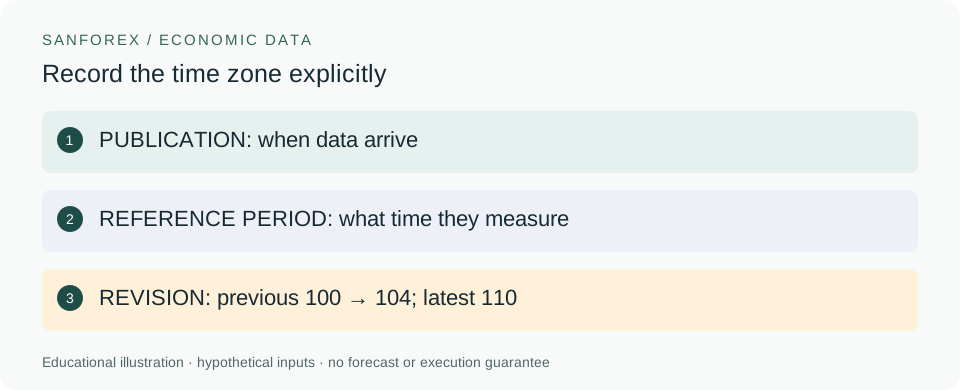
Hypothetical example: PUBLICATION: when data arrive. REFERENCE PERIOD: what time they measure. REVISION: previous 100 → 104; latest 110.
Open full-size diagram ↗Separate actual, previous and revised values
Consider an invented monthly series. Last month’s first publication was 100. The new release reports the latest month as 110 and revises the earlier month to 104. The latest month is six units above the revised prior value, not ten. Keep both the initial and revised prior observations if your purpose is to reconstruct what a reader could have known at the earlier publication time. Replacing old notes without preserving the revision history makes that reconstruction impossible.
Label forecasts by who produced them
A third-party calendar may display a consensus or forecast beside an official result. Record that forecast’s source and collection time; it is not necessarily a statistic published by the agency. Ensure that units, frequency and adjustment basis match before calculating a difference. If a hypothetical forecast is 108 and the reported result is 110, the numerical difference is two units. That subtraction does not determine whether the data are broadly strong, whether expectations were fully captured, or how prices should react.
Use a compact release-note template
Record issuing agency, exact series, reference period, scheduled publication time and zone, actual publication timestamp if available, result, units, prior value, revision and source URL. Add third-party expectations only in a separately labeled field. SanForex’s market-hours tool shows indicative city sessions and can help inspect a chosen UTC instant; it does not list economic releases or predict volatility. When the schedule changes, update the appointment from the official source and retain the previous note if it matters to your audit.
Sources and conventions
Examples are hypothetical. Worked examples state their formulas and assumptions in the article; our methodology explains the related calculators. Broker contract specifications determine actual lot, margin and execution conditions. These sources document definitions and data; a source link does not imply endorsement of SanForex or a trading service.
These materials are prepared with AI assistance and checked against worked examples and deterministic calculation tests where applicable. They are not an expert suitability assessment or investment advice.
Open market hours tool ↗