Why exponential moving averages can disagree at the start
An exponential moving average depends on its previous value, so a reproducible calculation needs an initialization rule.
Separate the update rule from the starting value
An exponential moving average depends on its previous value, so a reproducible calculation needs an initialization rule. For the common smoothing factor alpha = 2 / (N + 1), a period length of 3 gives alpha = 0.5. The next average is 0.5 times the new observation plus 0.5 times the previous average. This example demonstrates the recursion; it does not prescribe a chart setting.
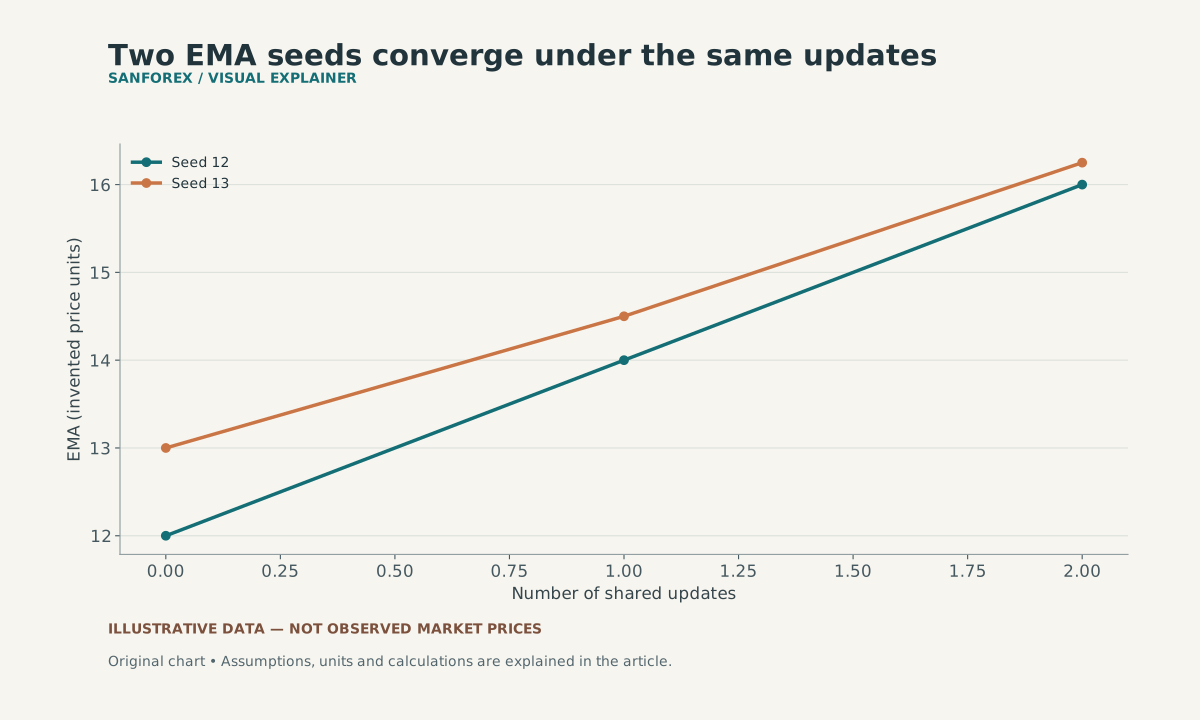
With alpha 0.5 and subsequent closes of 16 and 18, seeds of 12 and 13 produce EMA paths 12–14–16 and 13–14.5–16.25. The seed gap halves with each shared update.
Open full-size diagram ↗Calculate one update with two seeds
Suppose the next close is 16. If the previous average is 12, the new value is 14. If a different initialization produced a previous average of 13, the new value is 14.5. With a following close of 18, those paths become 16 and 16.25. Both calculations apply the same formula but carry different earlier histories.
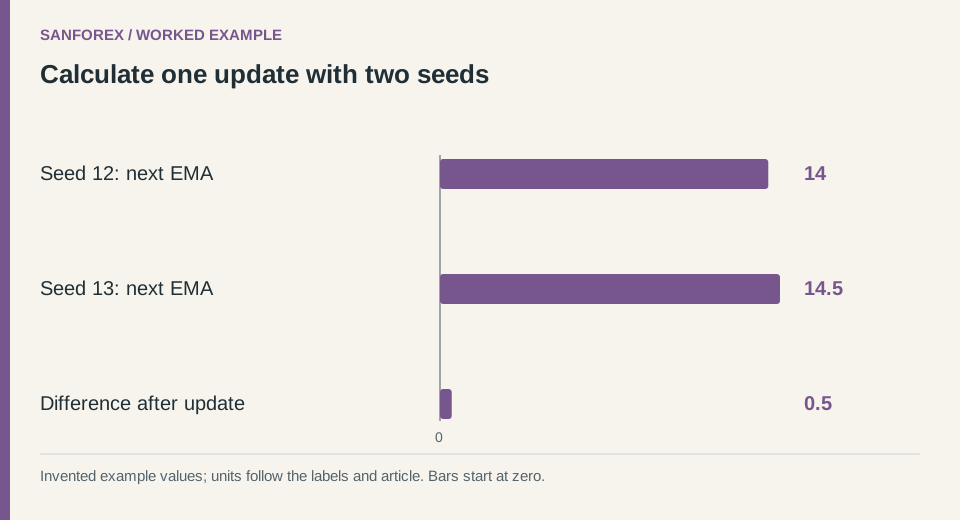
Worked example: Seed 12: next EMA: 14; Seed 13: next EMA: 14.5; Difference after update: 0.5. Invented values; units follow the row labels and article.
Open full-size diagram ↗Explain a shrinking difference
The seed difference of 1 becomes 0.5 after one shared update and 0.25 after two. In this example it is multiplied by 0.5 each step. That does not mean the two series become exactly identical after a universal number of bars. Rounding and the amount of prior history also matter when reconciling an export with a chart.
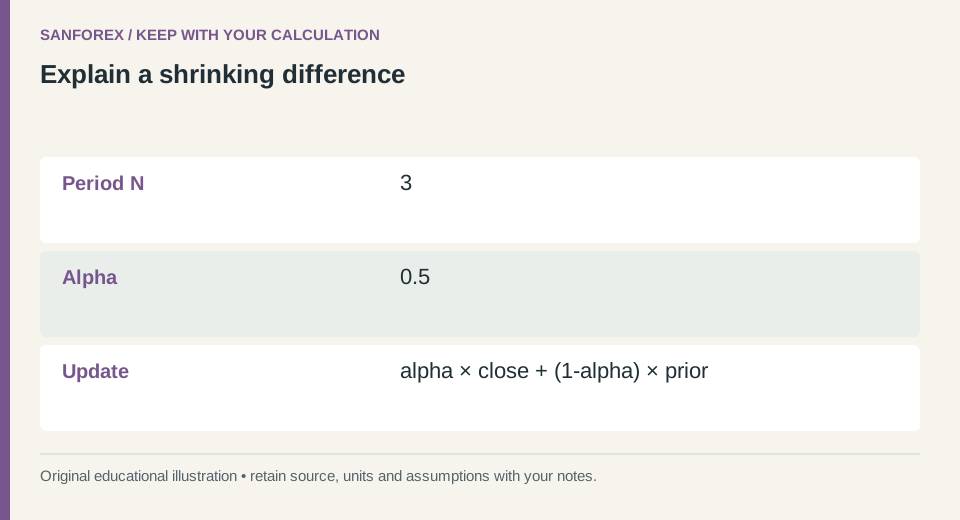
Calculation checklist: Period N: 3; Alpha: 0.5; Update: alpha × close + (1-alpha) × prior. Preserve these definitions when reproducing the example.
Open full-size diagram ↗Keep a small audit table
Save the period, alpha, seed, input field and history start. Compare the first few updates manually before comparing thousands of rows. If the later values still diverge materially, check missing observations and bar boundaries rather than assuming that initialization explains everything. EMA values describe a transformation of the inputs, not an independently verified signal or an expected return.
Sources and conventions
Examples are hypothetical. Worked examples state their formulas and assumptions in the article; our methodology explains the related calculators. Broker contract specifications determine actual lot, margin and execution conditions. These sources document definitions and data; a source link does not imply endorsement of SanForex or a trading service.
These materials are prepared with AI assistance and checked against worked examples and deterministic calculation tests where applicable. They are not an expert suitability assessment or investment advice.
Open trading journal tool ↗