True range includes a gap that high minus low can miss
High minus low measures the distance covered between a bar’s extremes.
Begin with the ordinary bar range
High minus low measures the distance covered between a bar’s extremes. It does not necessarily include the distance from the previous close to the new bar. In an invented example, the previous close is 100, the next high is 108 and the next low is 105. The ordinary range is 3 price units, even though the entire new bar sits above the previous close.
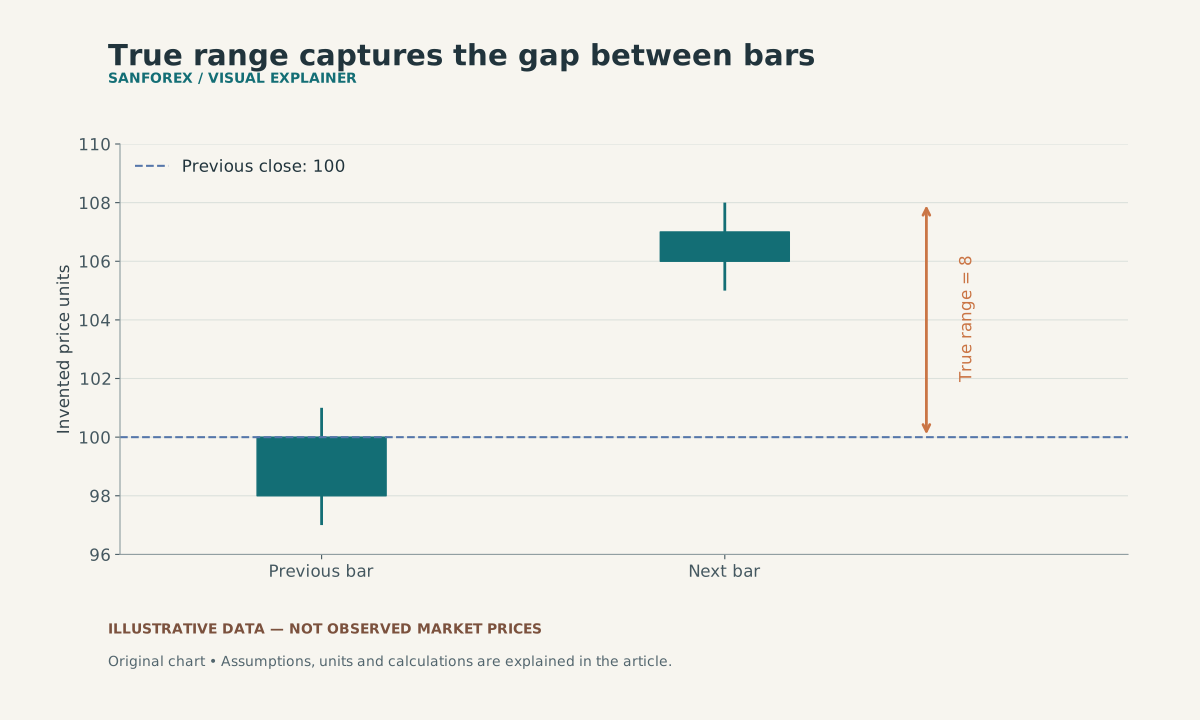
Synthetic candles show previous close 100 and next high 108 / low 105: bar range is 3, true range is 8. Added illustrative opens and prior extremes draw the candles; these are not market observations.
Open full-size diagram ↗Check all three candidate distances
True range takes the largest of high minus low, the absolute high-to-previous-close distance and the absolute low-to-previous-close distance. The three candidates here are 3, 8 and 5, so true range is 8. Absolute values keep the previous-close comparisons nonnegative. A downward gap is handled by the same calculation.
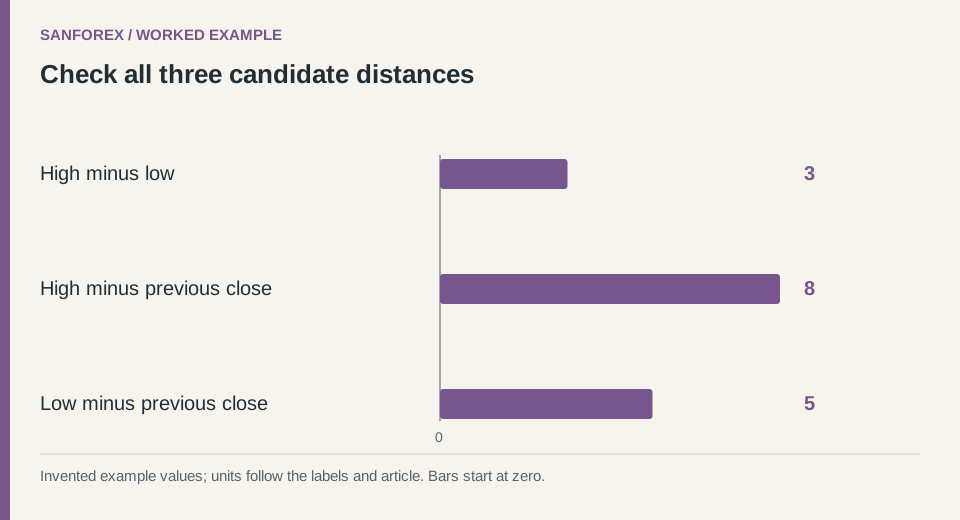
Worked example: High minus low: 3; High minus previous close: 8; Low minus previous close: 5. Invented values; units follow the row labels and article.
Open full-size diagram ↗Distinguish one true range from an average
The value 8 belongs to one bar. Average true range combines a sequence of true ranges using a specified smoothing method and length. Do not label a single true-range value as a multi-period ATR. Platform settings and initialization can affect an averaged series, so retain the smoothing method when comparing calculations.
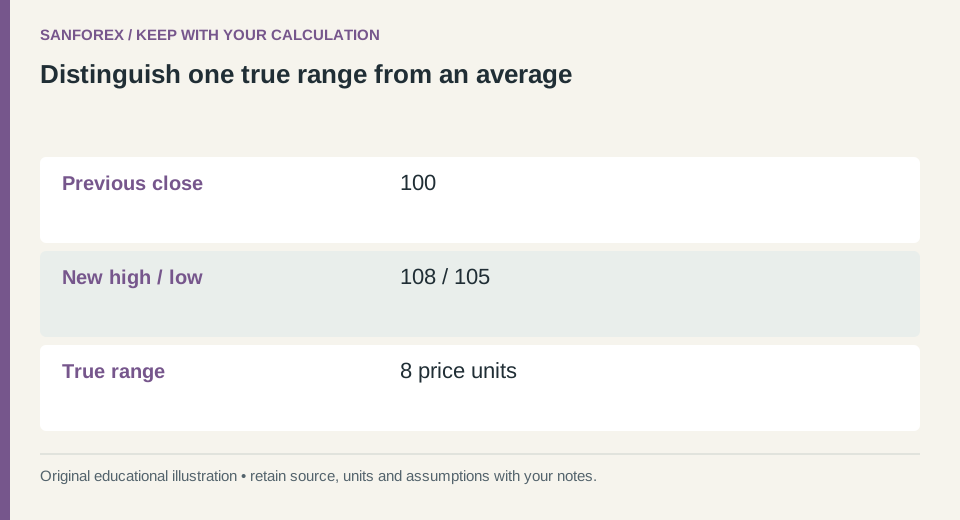
Calculation checklist: Previous close: 100; New high / low: 108 / 105; True range: 8 price units. Preserve these definitions when reproducing the example.
Open full-size diagram ↗Use consistent data and units
The current high, low and previous close must refer to compatible bars and price adjustments. A price-unit range is not automatically a cash loss, a probability or a direction forecast. Position size and contract details are separate inputs. Check a gap example manually when validating an indicator because a quiet continuous example may conceal an implementation that only calculates high minus low.
Sources and conventions
Examples are hypothetical. Worked examples state their formulas and assumptions in the article; our methodology explains the related calculators. Broker contract specifications determine actual lot, margin and execution conditions. These sources document definitions and data; a source link does not imply endorsement of SanForex or a trading service.
These materials are prepared with AI assistance and checked against worked examples and deterministic calculation tests where applicable. They are not an expert suitability assessment or investment advice.
Open trading journal tool ↗