Mean and median trade results tell different stories
One average can conceal a highly uneven set of outcomes.
Preserve the full distribution
One average can conceal a highly uneven set of outcomes. Consider five invented net trade results, all in the same currency: minus 10, minus 5, zero, 5 and 110. Their total is 100. The arithmetic mean is 20, while the median, the middle sorted observation, is zero. Both summaries are correct for this dataset.
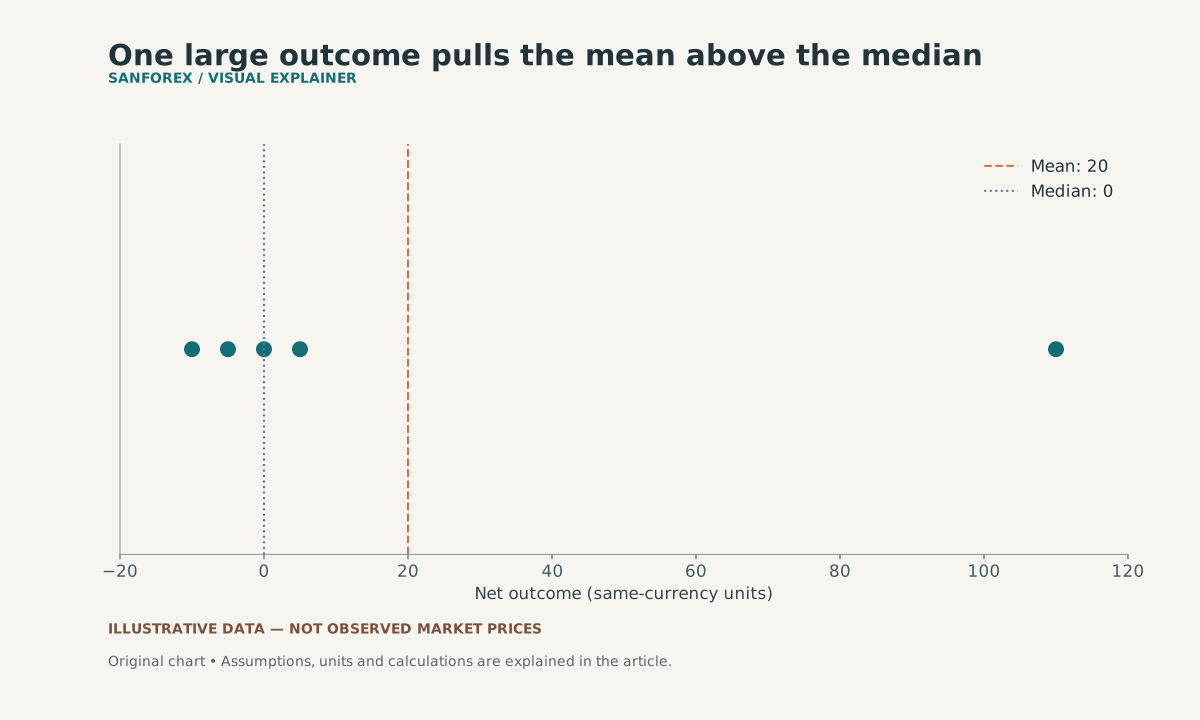
Five invented outcomes -10, -5, 0, 5 and 110 total 100. The mean is 20 and the median is zero. The isolated large observation is retained; unusual size alone is not a reason to delete it.
Open full-size diagram ↗See what the large observation changes
If the last result had been 10 instead of 110, the total and mean would both be zero, and the median would remain zero. The large positive result moves the mean substantially without changing the middle observation. This sensitivity is part of what the mean measures, not automatically a reason to delete the result.
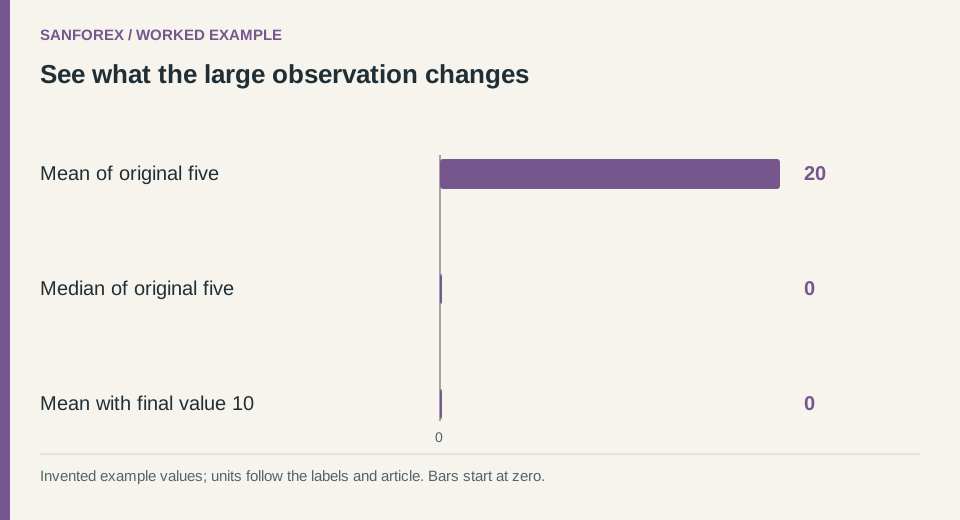
Worked example: Mean of original five: 20; Median of original five: 0; Mean with final value 10: 0. Invented values; units follow the row labels and article.
Open full-size diagram ↗Check a suspicious value before excluding it
A large outcome might be valid, a duplicated record, a currency mismatch or a decimal error. Reconcile it to the source record first. If an exclusion is justified, retain the reason and report the before-and-after totals and counts. Removing an authentic result solely because it looks unusual changes the question the summary answers.
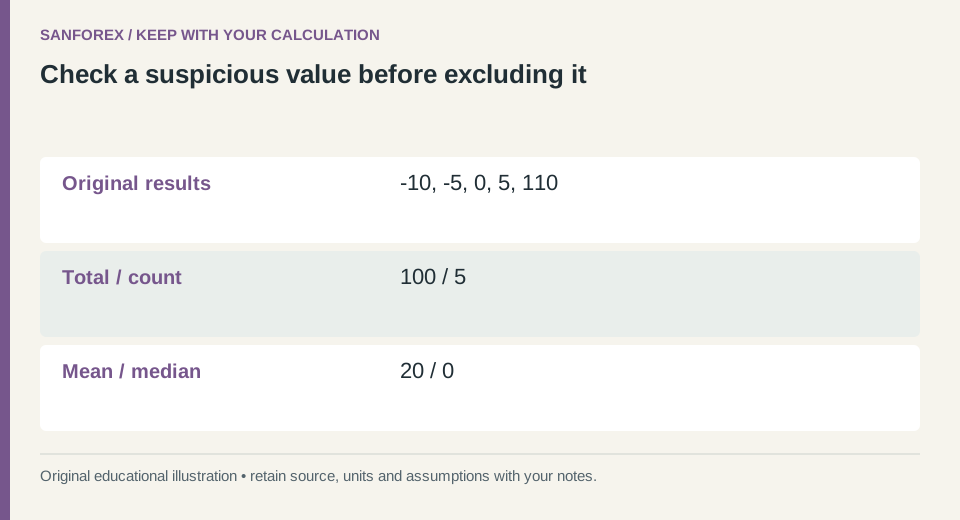
Calculation checklist: Original results: -10, -5, 0, 5, 110; Total / count: 100 / 5; Mean / median: 20 / 0. Preserve these definitions when reproducing the example.
Open full-size diagram ↗Pair summaries with context
Report the count, total, mean and median together, plus the unit and whether costs are included. For an even number of observations, state the convention used for the median; the usual convention averages the two middle values. Neither the mean of this small sample nor its median provides an estimate of future performance without further assumptions and evidence.
Sources and conventions
Examples are hypothetical. Worked examples state their formulas and assumptions in the article; our methodology explains the related calculators. Broker contract specifications determine actual lot, margin and execution conditions. These sources document definitions and data; a source link does not imply endorsement of SanForex or a trading service.
These materials are prepared with AI assistance and checked against worked examples and deterministic calculation tests where applicable. They are not an expert suitability assessment or investment advice.
Open trading journal tool ↗