Why rounding each row can disagree with rounding the total
Rounding is part of a reconciliation, not merely a display preference.
Put the rounding rule in the calculation
Rounding is part of a reconciliation, not merely a display preference. A provider may round individual charges before adding them, or retain more precision and round only the final amount. These procedures can produce different totals from identical unrounded inputs. State the number of decimal places, tie-breaking convention and point in the workflow where rounding occurs.
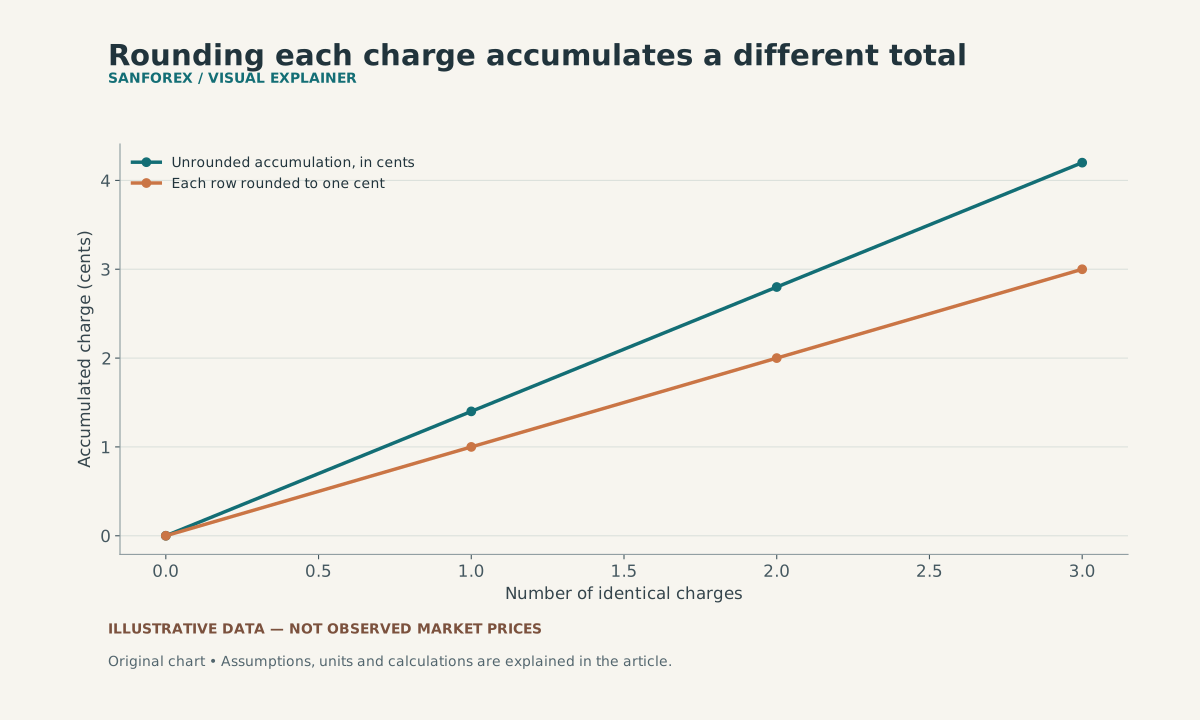
Three charges of 0.014 currency units accumulate to 4.2 cents before final rounding, or 3 cents if each charge rounds first. Final sum rounding produces 4 cents, not the 3-cent row-rounded total.
Open full-size diagram ↗Use a three-row example without ties
Take three invented charges of 0.014 currency units each. Rounding each to two decimal places gives 0.01 + 0.01 + 0.01 = 0.03. Adding first gives 0.042, which rounds to 0.04. The difference is 0.01. No halfway case is involved, so this example isolates the order of operations rather than a tie-breaking disagreement.
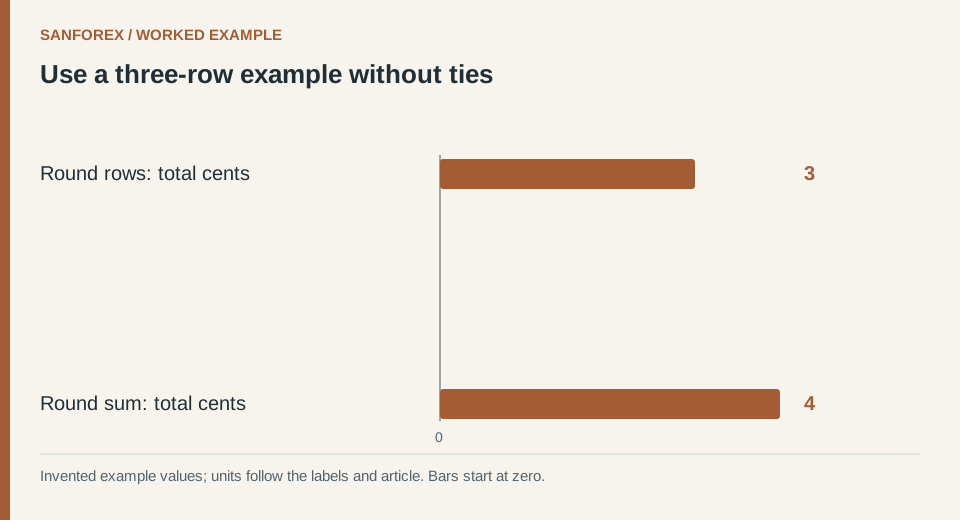
Worked example: Round rows: total cents: 3; Round sum: total cents: 4. Invented values; units follow the row labels and article.
Open full-size diagram ↗Preserve source amounts and precision
If the statement contains only settled two-decimal charges, use those documented amounts for reconciliation rather than reconstructing invisible precision. When a calculation starts with higher-precision values, preserve them separately from displayed amounts. Decimal arithmetic or integer minor units can prevent binary floating-point artifacts, but neither approach chooses the correct business rounding policy for you.
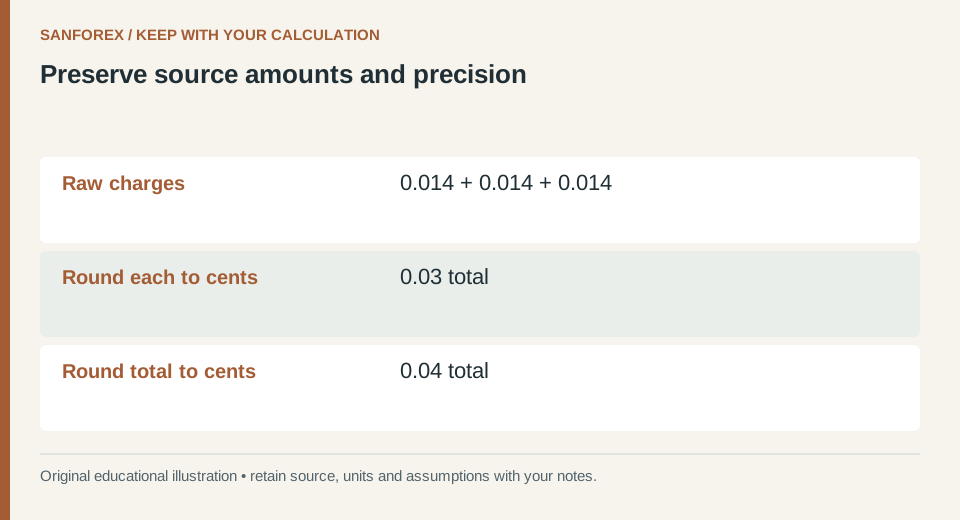
Calculation checklist: Raw charges: 0.014 + 0.014 + 0.014; Round each to cents: 0.03 total; Round total to cents: 0.04 total. Preserve these definitions when reproducing the example.
Open full-size diagram ↗Explain small residuals rather than hiding them
Record the row count, source precision, rounding stage and final comparison. A small difference may be explained by rounding, but do not assume every small discrepancy has that cause. Check omitted fees, rejected rows and conversion differences as well. If an adjustment is necessary, label it explicitly and preserve the original report so another reader can follow the reconciliation.
Sources and conventions
Examples are hypothetical. Worked examples state their formulas and assumptions in the article; our methodology explains the related calculators. Broker contract specifications determine actual lot, margin and execution conditions. These sources document definitions and data; a source link does not imply endorsement of SanForex or a trading service.
These materials are prepared with AI assistance and checked against worked examples and deterministic calculation tests where applicable. They are not an expert suitability assessment or investment advice.
Open trade csv checker tool ↗