Holding duration: elapsed clock time is not session time
Holding duration can mean elapsed time between two instants or time counted only inside a specified session calendar.
Choose the duration you intend to measure
Holding duration can mean elapsed time between two instants or time counted only inside a specified session calendar. These definitions need not agree. A journal should label the basis rather than displaying an unexplained number of hours. Use timezone-aware instants for elapsed time so local clock changes do not silently alter subtraction.
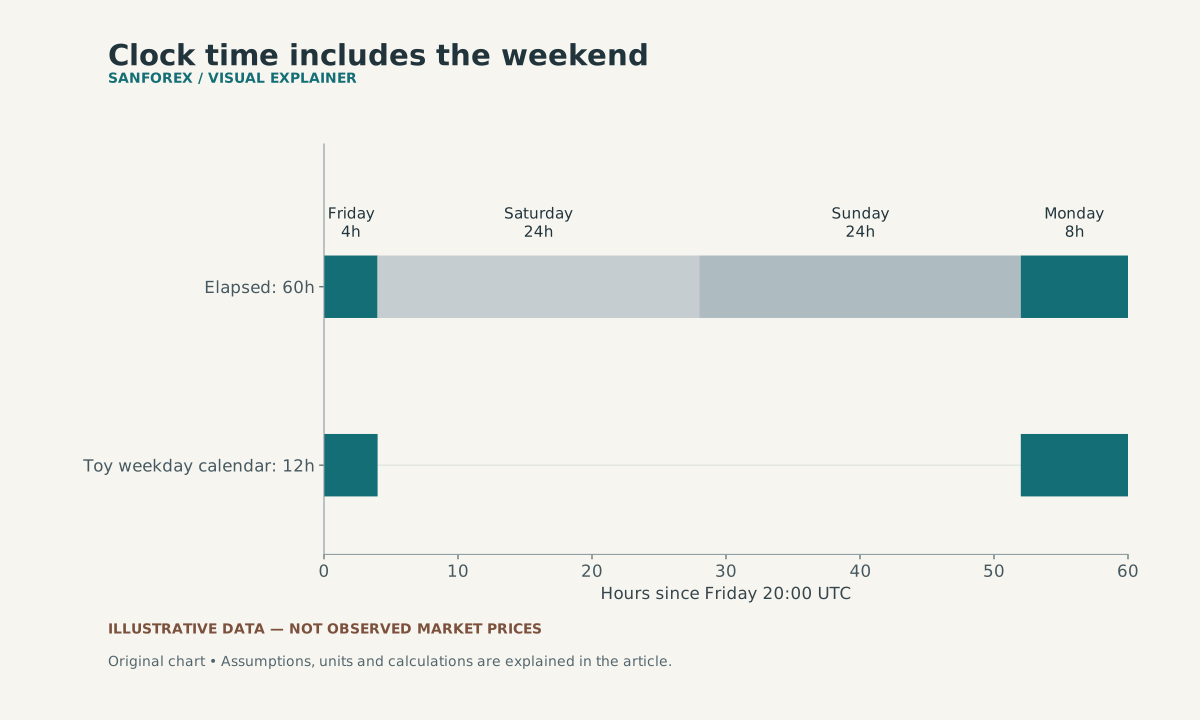
Friday 20:00 UTC to Monday 08:00 UTC spans 60 elapsed hours. A deliberately simplified weekday-only UTC calendar counts four Friday hours and eight Monday hours. This is not actual market-session availability.
Open full-size diagram ↗Subtract two explicit UTC timestamps
An invented position opens on a Friday at 20:00 UTC and closes the following Monday at 08:00 UTC. Elapsed time is 12 hours to Saturday morning plus 48 hours to Monday morning, or 60 hours total. Equivalently, it is two days and twelve hours. No market-opening assumption is needed for that clock-time calculation.
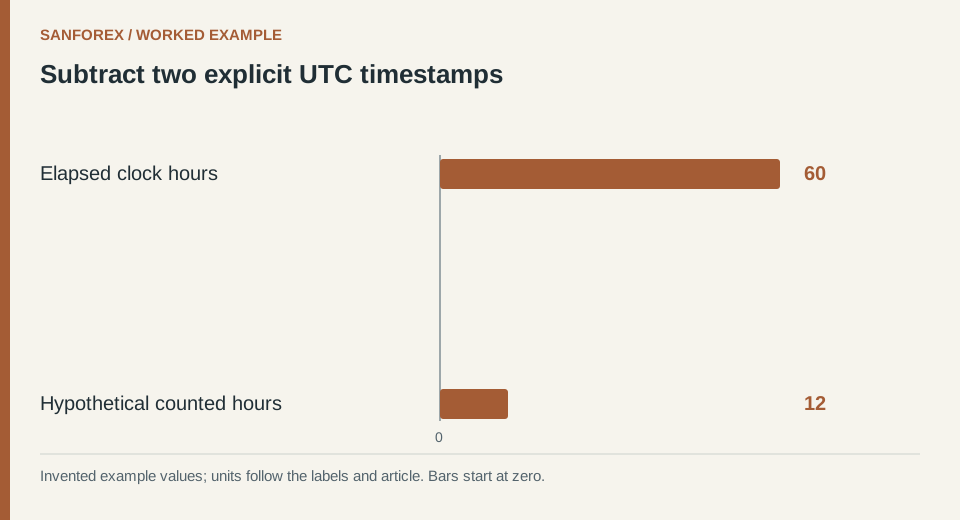
Worked example: Elapsed clock hours: 60; Hypothetical counted hours: 12. Invented values; units follow the row labels and article.
Open full-size diagram ↗Apply a hypothetical calendar separately
Suppose a deliberately simplified calendar counts only weekdays from 00:00 to 24:00 UTC and excludes the whole weekend. Under that stated rule, the interval contains 4 counted hours on Friday and 8 on Monday, totaling 12. This is a teaching calendar, not actual forex, exchange or broker trading hours. A real session measure needs the relevant holidays and closures.
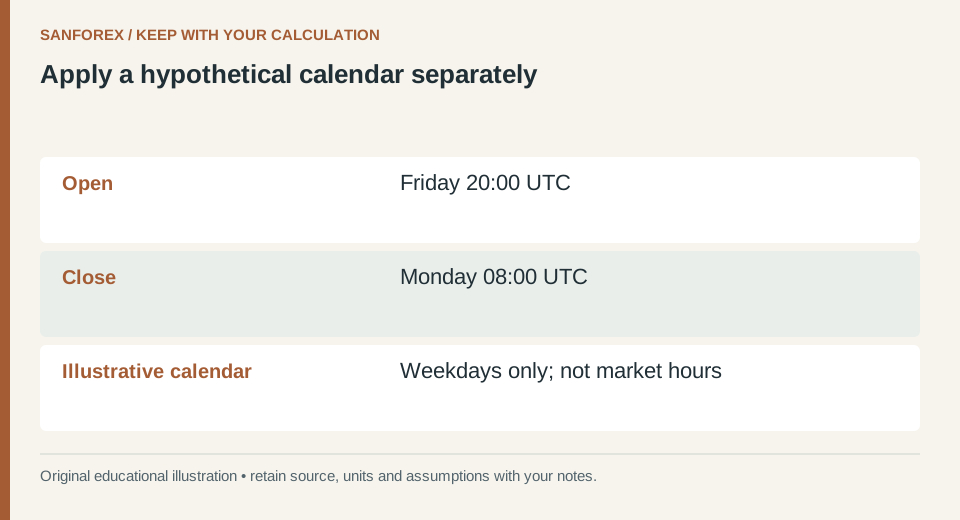
Calculation checklist: Open: Friday 20:00 UTC; Close: Monday 08:00 UTC; Illustrative calendar: Weekdays only; not market hours. Preserve these definitions when reproducing the example.
Open full-size diagram ↗Keep durations separate from financing charges
A 60-hour elapsed interval does not by itself determine financing or rollover charges. Contract terms, cutoff times and settlement conventions can matter. Preserve open and close timestamps, duration basis and calendar version in the journal. When comparing average holding times across strategies, use the same basis and treat still-open positions separately from completed durations.
Sources and conventions
Examples are hypothetical. Worked examples state their formulas and assumptions in the article; our methodology explains the related calculators. Broker contract specifications determine actual lot, margin and execution conditions. These sources document definitions and data; a source link does not imply endorsement of SanForex or a trading service.
These materials are prepared with AI assistance and checked against worked examples and deterministic calculation tests where applicable. They are not an expert suitability assessment or investment advice.
Open trading journal tool ↗