MFE and MAE require the price path during the position
Maximum favorable excursion and maximum adverse excursion summarize how far a price moved for or against a position during a defined holding interval.
Entry and exit do not describe the whole path
Maximum favorable excursion and maximum adverse excursion summarize how far a price moved for or against a position during a defined holding interval. This article uses nonnegative price-distance magnitudes for both measures. Other reporting conventions may use signed values or cash amounts, so define the units and sign convention before comparing journals.
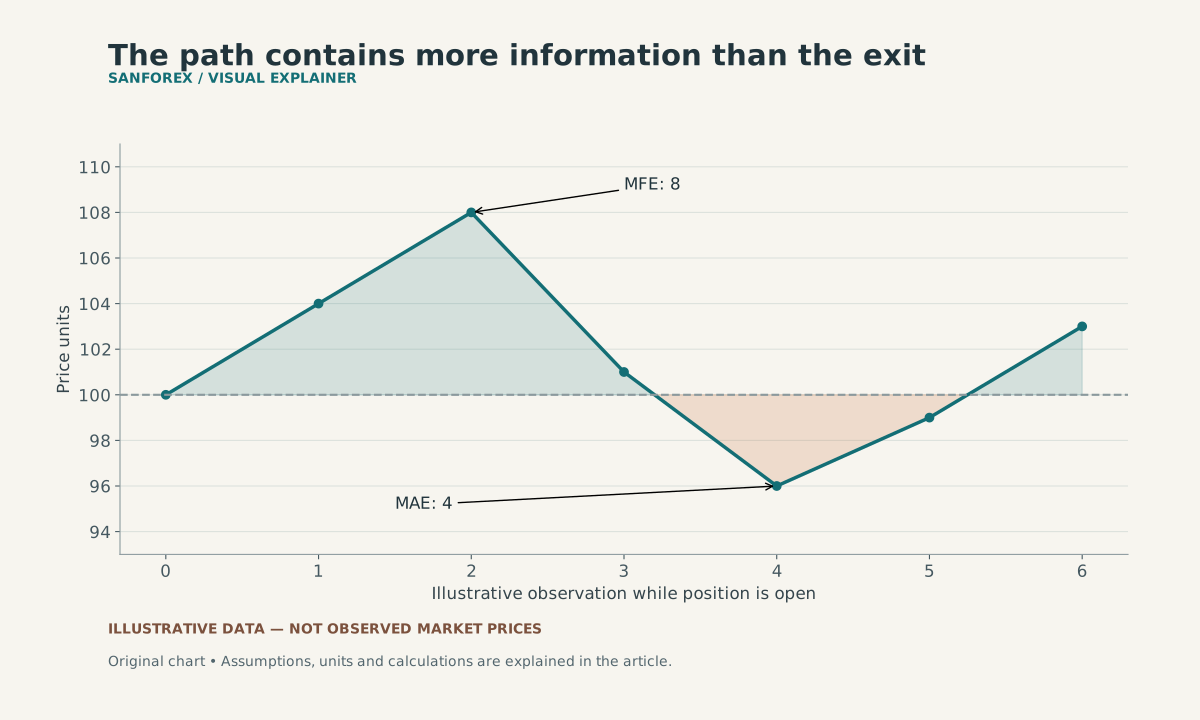
One synthetic path consistent with entry 100, high 108, low 96 and exit 103. Its MFE is 8 and MAE magnitude is 4 price units. Intermediate points are invented; extremes are not guaranteed execution prices.
Open full-size diagram ↗Calculate a simple long-position example
Suppose a long entry is 100, the highest observed price while the position is open is 108, the lowest is 96 and the exit is 103. MFE is 8 price units and MAE is 4 under our magnitude convention. The final favorable price change is 3. The three numbers describe different features of the same invented path.
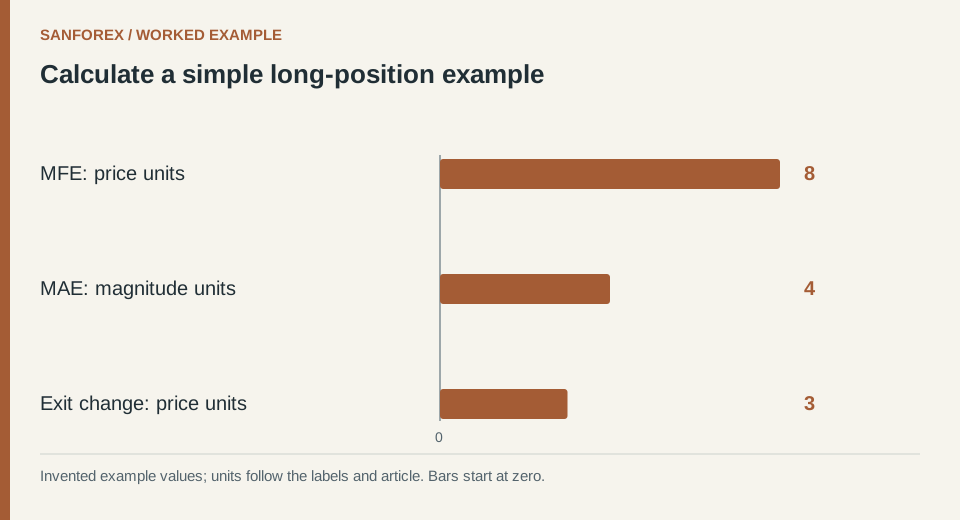
Worked example: MFE: price units: 8; MAE: magnitude units: 4; Exit change: price units: 3. Invented values; units follow the row labels and article.
Open full-size diagram ↗Check the observation interval carefully
A bar that contains both the entry and an earlier extreme can overstate an excursion if its entire high or low is included. The same problem occurs on the exit bar. Higher-resolution data or an explicitly approximate convention may be needed. OHLC data alone also does not reveal the ordering of all price movements within a bar.
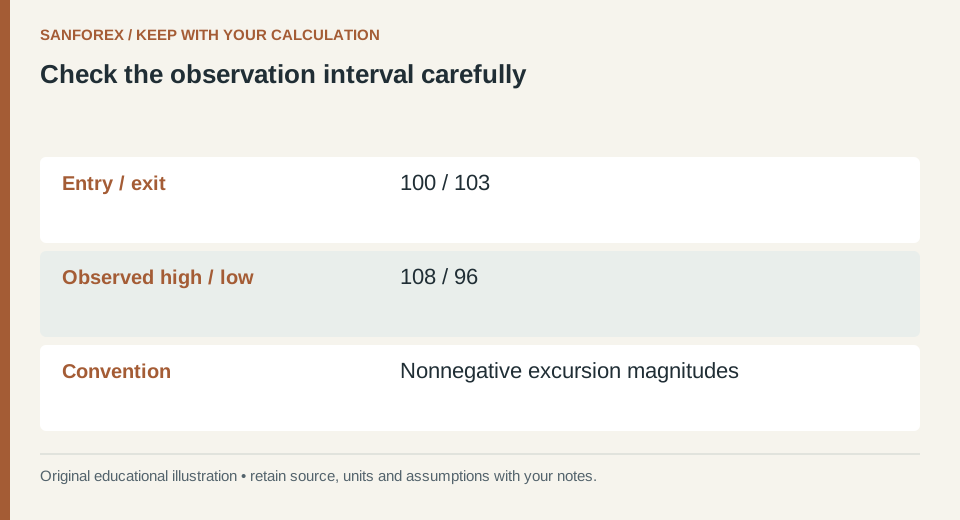
Calculation checklist: Entry / exit: 100 / 103; Observed high / low: 108 / 96; Convention: Nonnegative excursion magnitudes. Preserve these definitions when reproducing the example.
Open full-size diagram ↗Do not convert observed extremes into guaranteed fills
An observed high is not proof that a particular order could have executed there. Spread, available liquidity and order timing remain separate questions. Keep the price source, interval boundaries and whether the measure uses bid, ask or another series. If position size changes, cash excursion requires more information than multiplying one constant size by the full-period extreme.
Sources and conventions
Examples are hypothetical. Worked examples state their formulas and assumptions in the article; our methodology explains the related calculators. Broker contract specifications determine actual lot, margin and execution conditions. These sources document definitions and data; a source link does not imply endorsement of SanForex or a trading service.
These materials are prepared with AI assistance and checked against worked examples and deterministic calculation tests where applicable. They are not an expert suitability assessment or investment advice.
Open trading journal tool ↗