One order, several fills: choose the right journal record unit
An order is an instruction, while a fill records an execution.
Name the object each row represents
An order is an instruction, while a fill records an execution. A journal’s trade may group several executions into one position lifecycle or trading idea. These are different record units. Before comparing counts between a broker export and a journal, establish whether the rows represent orders, fills, closed positions or another explicitly defined grouping.
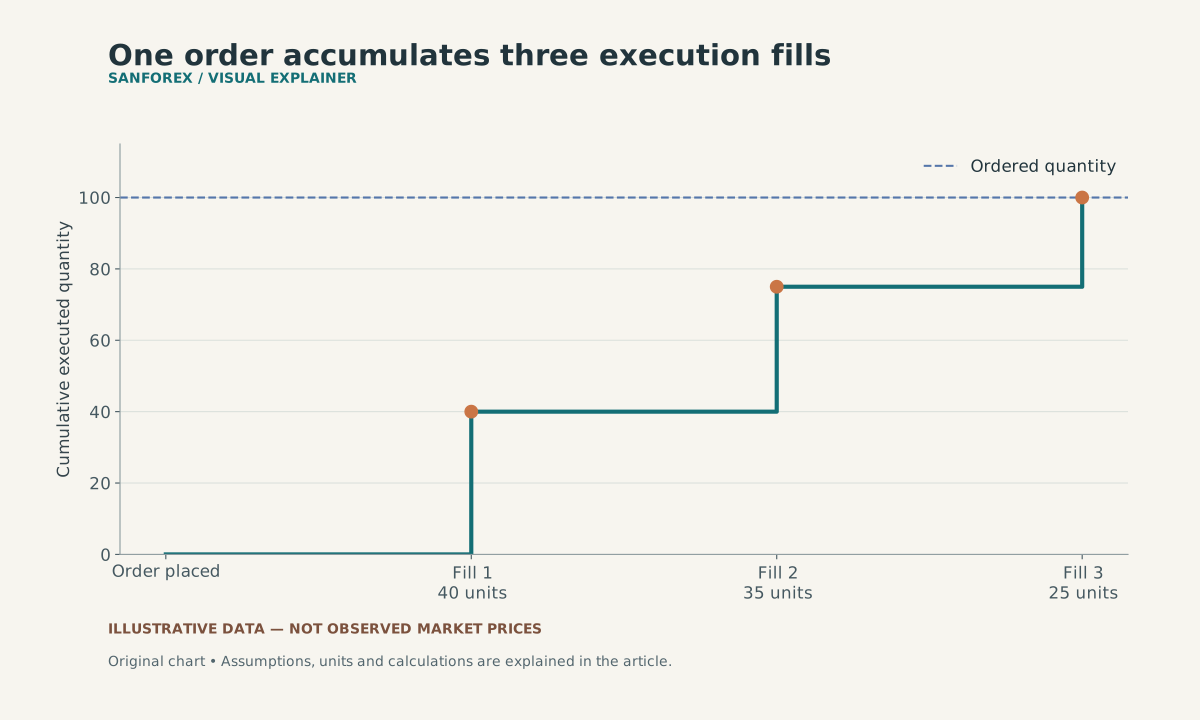
Fills of 40, 35 and 25 units accumulate to one 100-unit order. Steps distinguish execution events from an order count; prices and fees remain separately recorded.
Open full-size diagram ↗Follow one order through three fills
An invented order for 100 units fills as 40 units at 10.00, 35 at 10.10 and 25 at 10.20. That is one order and three fills, totaling 100 units. The filled notional is 1,008.50 price-currency units and the quantity-weighted average fill price is 10.085. Counting each fill as a separate completed trade would change the meaning of the journal’s trade count.
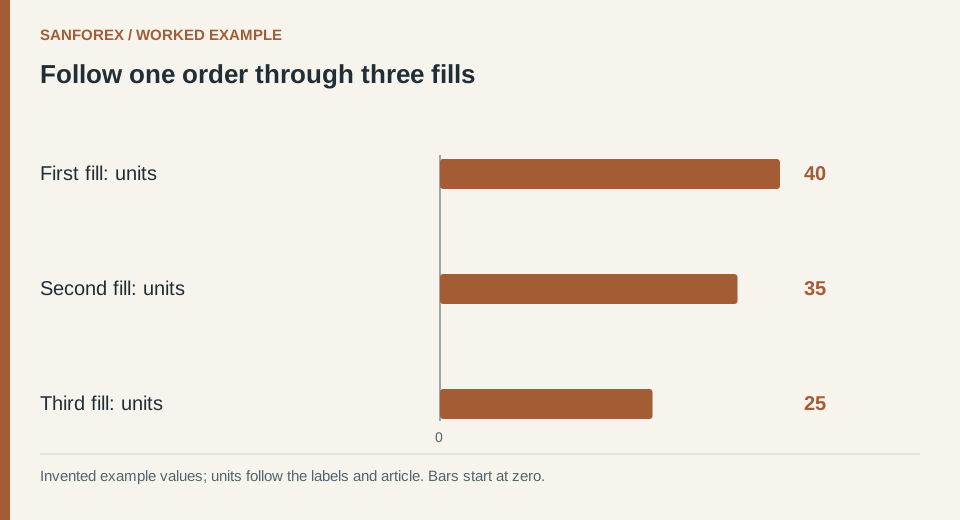
Worked example: First fill: units: 40; Second fill: units: 35; Third fill: units: 25. Invented values; units follow the row labels and article.
Open full-size diagram ↗Keep relationships instead of discarding detail
Retain an order identifier, fill identifiers, quantities, prices and timestamps. If a later exit also arrives in several fills, link those records using an explicit rule. Partial cancellation should not be converted into a fictitious execution. Fees may be attached to an order or individual fills; reconcile their total before allocating them to a grouped trade.
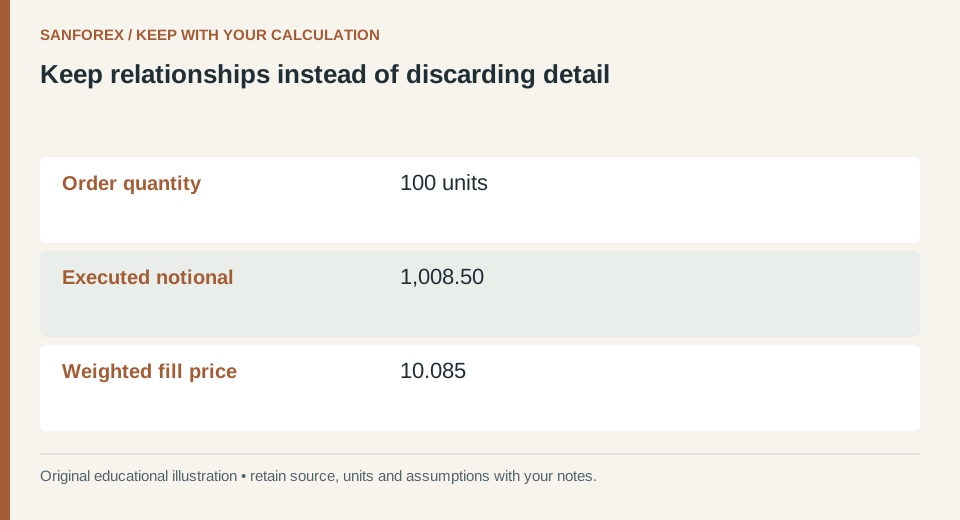
Calculation checklist: Order quantity: 100 units; Executed notional: 1,008.50; Weighted fill price: 10.085. Preserve these definitions when reproducing the example.
Open full-size diagram ↗Reconcile quantity and money independently
Check that summed fill quantities match the executed quantity and that fill notionals reproduce the weighted price. Then compare fees and the chosen closed-trade grouping. A difference in row counts is not automatically missing money, but it needs an explanation. This example is generic bookkeeping and does not specify a broker’s contract terms, execution guarantees or tax-lot accounting method.
Sources and conventions
Examples are hypothetical. Worked examples state their formulas and assumptions in the article; our methodology explains the related calculators. Broker contract specifications determine actual lot, margin and execution conditions. These sources document definitions and data; a source link does not imply endorsement of SanForex or a trading service.
These materials are prepared with AI assistance and checked against worked examples and deterministic calculation tests where applicable. They are not an expert suitability assessment or investment advice.
Open trading journal tool ↗