Basis points, percentage points and relative change
A change between two rates can be described in basis points, percentage points or relative percent.
Choose the unit of change
A change between two rates can be described in basis points, percentage points or relative percent. These descriptions answer different questions. One basis point is one hundredth of a percentage point. Record whether the original number is a percentage, a decimal fraction or a monetary amount before calculating; a spreadsheet cell displaying 4% may store 0.04.
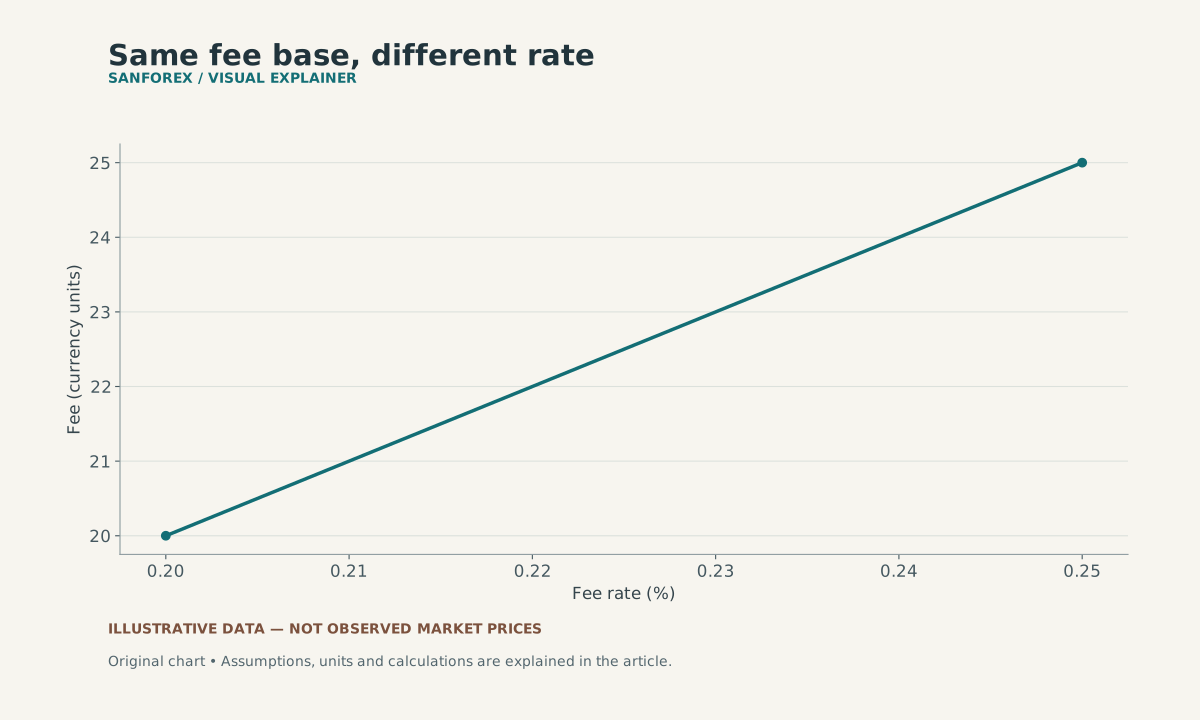
A fixed 10,000-unit base produces fees of 20 at 0.20% and 25 at 0.25%. The five-unit cash increase corresponds to five basis points, not five percentage points.
Open full-size diagram ↗Calculate the same move three ways
Use an invented rate increase from 4.00% to 4.25%. Subtracting the displayed percentages gives 0.25 percentage points, equivalent to 25 basis points. Dividing that 0.25-point increase by the original 4.00% gives a relative increase of 6.25%. All three describe the same move, but writing only a 6.25% rate rise can easily be mistaken for a new rate of 10.25%. The new level is still 4.25%.
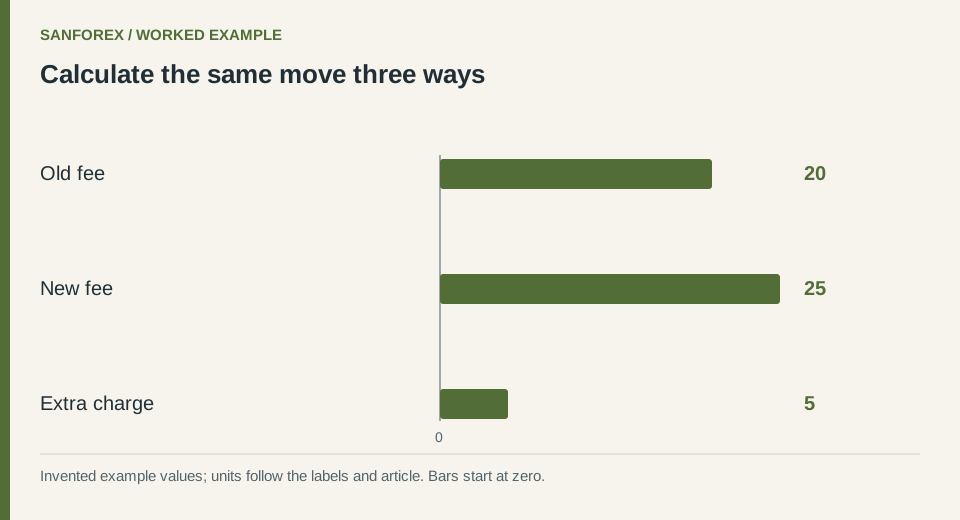
Worked example: Old fee: 20; New fee: 25; Extra charge: 5. Invented values; units follow the row labels and article.
Open full-size diagram ↗Translate a fee change into cash
For a hypothetical fixed 10,000-unit charge base, a fee moving from 0.20% to 0.25% increases from 20 to 25 currency units. The increase is five basis points and five currency units on that base. It is also a 25% relative increase in the fee rate. If the charge base changes, calculate both cash charges explicitly rather than attributing the entire cash difference to the rate.
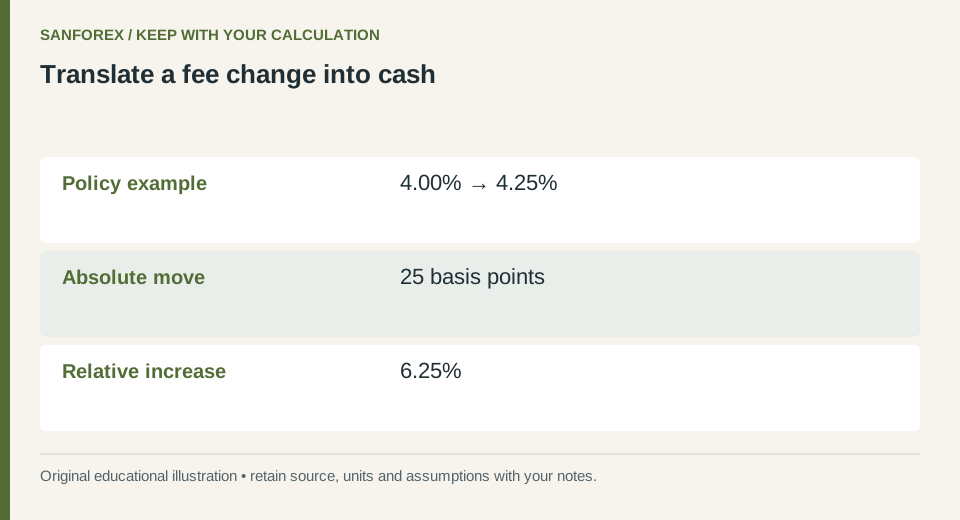
Calculation checklist: Policy example: 4.00% → 4.25%; Absolute move: 25 basis points; Relative increase: 6.25%. Preserve these definitions when reproducing the example.
Open full-size diagram ↗Write an unambiguous note
A useful note states old rate, new rate, absolute rate change and base amount separately. Federal Reserve material uses target ranges and policy-rate terminology; this example does not describe a current policy decision. SanForex risk/reward outputs use percentages in their own definitions, not central-bank rates. Always name the denominator and period when copying a percentage between worksheets.
Sources and conventions
Examples are hypothetical. Worked examples state their formulas and assumptions in the article; our methodology explains the related calculators. Broker contract specifications determine actual lot, margin and execution conditions. These sources document definitions and data; a source link does not imply endorsement of SanForex or a trading service.
These materials are prepared with AI assistance and checked against worked examples and deterministic calculation tests where applicable. They are not an expert suitability assessment or investment advice.
Open risk / reward tool ↗