Cross-currency rates: let the units choose multiply or divide
A cross rate connects two currencies through a third currency.
Treat rates as fractions with labels
A cross rate connects two currencies through a third currency. The safest way to decide whether to multiply or divide is to write each rate with its numerator and denominator. Matching currency units should cancel. A plausible-looking numeric result is not a substitute for this check, especially when a worksheet mixes rates quoted in opposite directions.
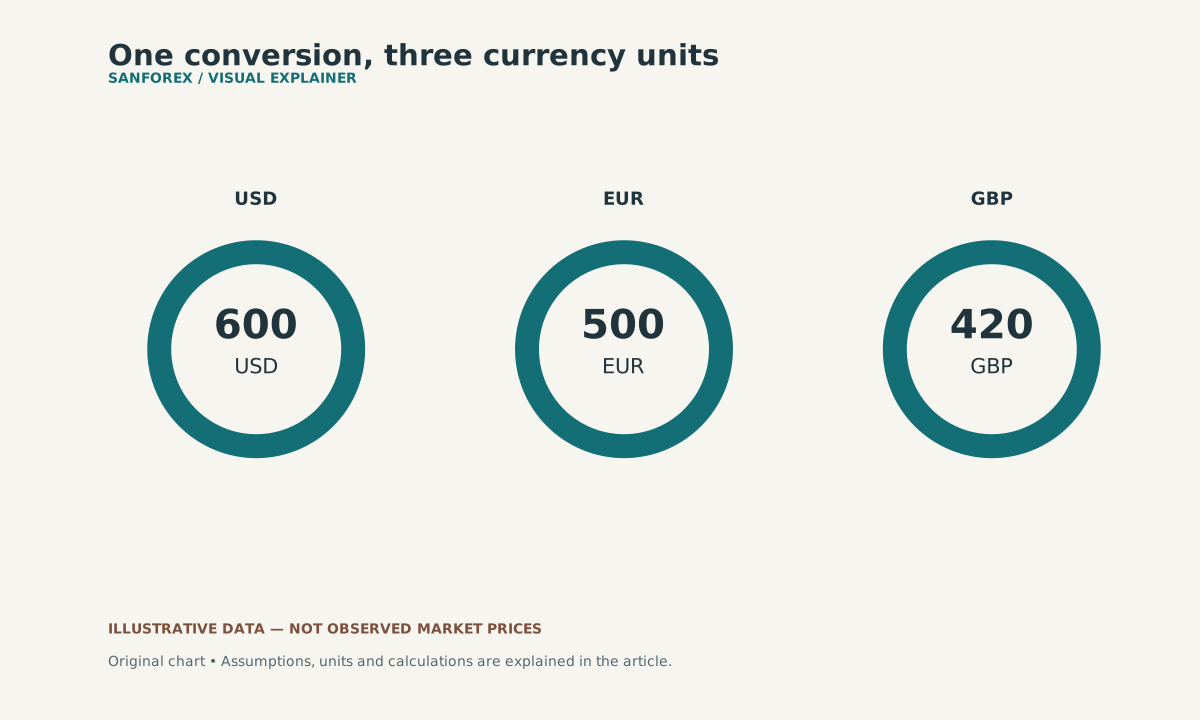
The same hypothetical conversion moves from 600 USD to 500 EUR to 420 GBP at the stated rates. Equal-size rings indicate stages, not a comparison of purchasing power.
Open full-size diagram ↗Build a complete hypothetical chain
Assume one EUR equals 1.20 USD and one EUR equals 0.84 GBP. To convert 600 USD to GBP, calculate 600 USD × (1 EUR / 1.20 USD) × (0.84 GBP / 1 EUR) = 420 GBP. USD and EUR cancel, leaving GBP. The cross rate is 0.84 ÷ 1.20 = 0.70 GBP per USD. Multiplying the two original numbers would leave incompatible units and produce the wrong conversion.
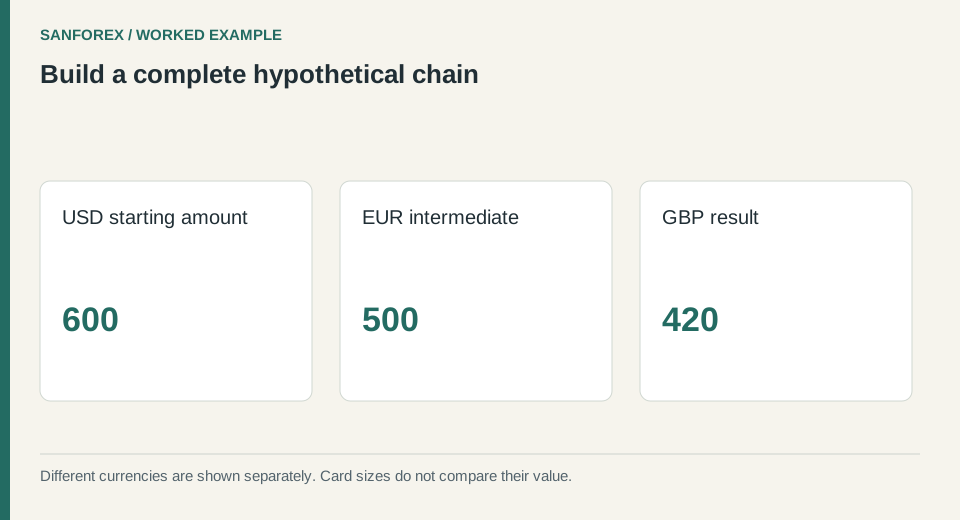
Worked example: USD starting amount: 600; EUR intermediate: 500; GBP result: 420. Invented values; units follow the row labels and article.
Open full-size diagram ↗Check the reverse without assuming a trading opportunity
Starting from 420 GBP, divide by 0.84 to obtain 500 EUR, then multiply by 1.20 to obtain 600 USD. The reverse check validates the arithmetic under a single coherent hypothetical rate set. With independently sourced quotes at different times, a mismatch may reflect timestamps, spreads, rounding or different data conventions. It is not automatically evidence of executable arbitrage.
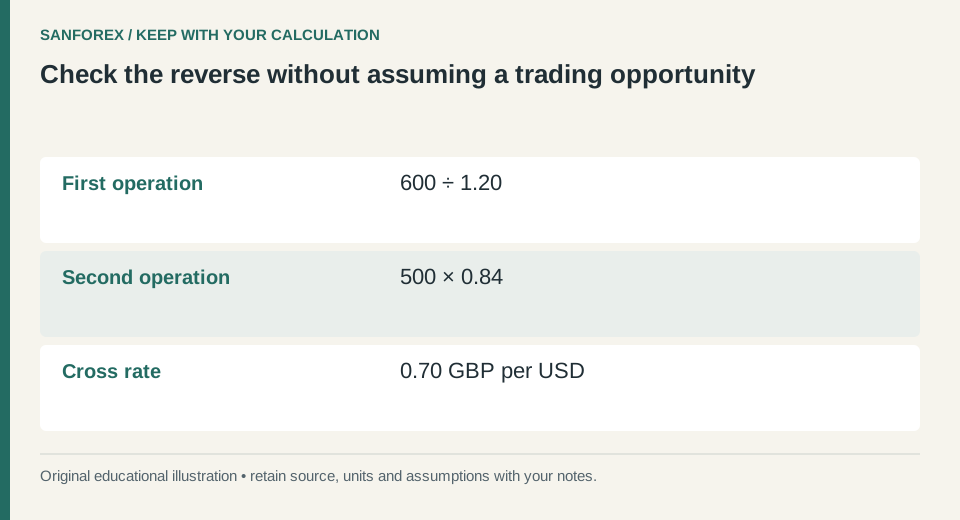
Calculation checklist: First operation: 600 ÷ 1.20; Second operation: 500 × 0.84; Cross rate: 0.70 GBP per USD. Preserve these definitions when reproducing the example.
Open full-size diagram ↗Store a rate table that can be audited
Label the common base, observation time, source and decimal precision for every rate. Do not combine today’s first leg with an earlier second leg without describing that choice. SanForex’s reference converter uses EUR-relative rates to calculate cross conversions. Its dated output is useful for arithmetic checking, while a real payment requires the provider’s applicable conversion and charges.
Sources and conventions
Examples are hypothetical. Worked examples state their formulas and assumptions in the article; our methodology explains the related calculators. Broker contract specifications determine actual lot, margin and execution conditions. These sources document definitions and data; a source link does not imply endorsement of SanForex or a trading service.
These materials are prepared with AI assistance and checked against worked examples and deterministic calculation tests where applicable. They are not an expert suitability assessment or investment advice.
Open currency converter tool ↗