Why reversing an exchange rate changes its percentage move
The reciprocal of a rate answers the reverse conversion question.
Write both currencies on the rate
The reciprocal of a rate answers the reverse conversion question. If one EUR buys 1.25 USD in a hypothetical example, one USD buys 1 ÷ 1.25 = 0.80 EUR. The currency units reverse with the number. A reciprocal is not obtained by changing a plus sign to a minus sign, and percentage changes do not remain numerically identical when a quote is inverted.
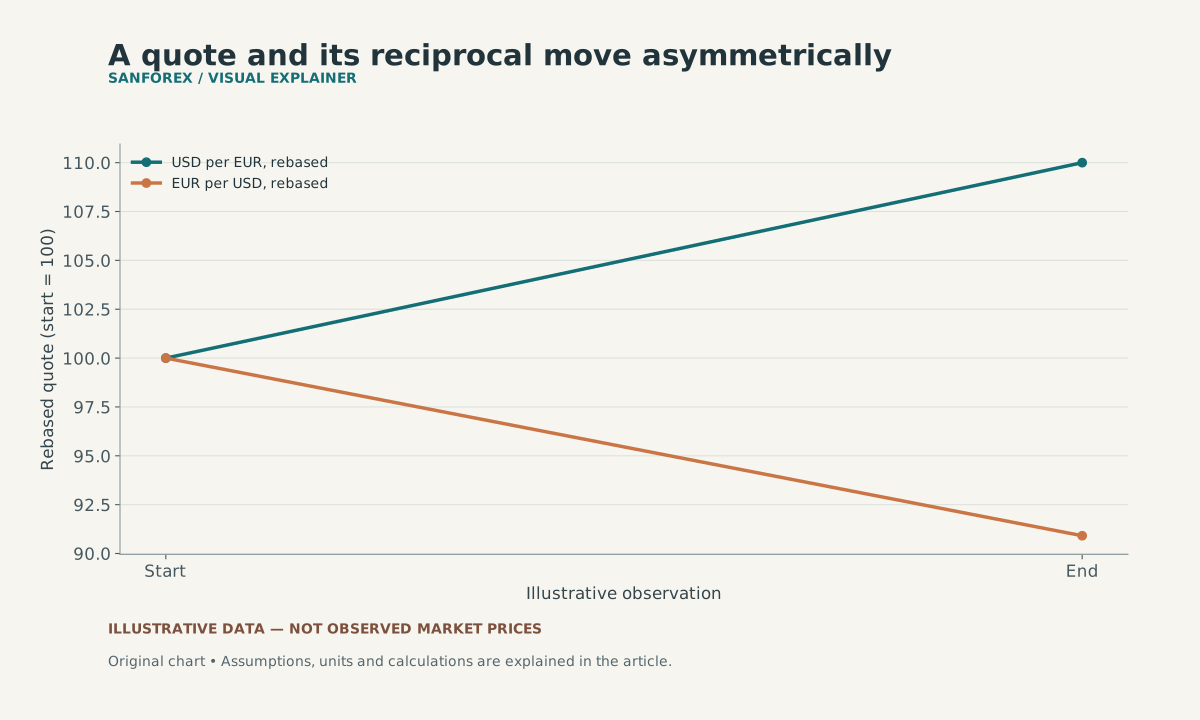
Rebasing both quote directions to 100 shows a 10% rise in USD per EUR and a 9.09% fall in its reciprocal. Hypothetical endpoints; connecting lines do not represent observed trading.
Open full-size diagram ↗Follow a ten-percent move
Suppose USD per EUR rises from 1.00 to 1.10, a 10% increase. The inverse quote falls from 1.00 to approximately 0.909091 EUR per USD. Its percentage change is about −9.09%, not −10%. Check the endpoints independently: 1 ÷ 1.10 produces the new inverse. A change of r in the original quote produces an inverse change of 1 ÷ (1 + r) − 1, provided the original rate remains positive.
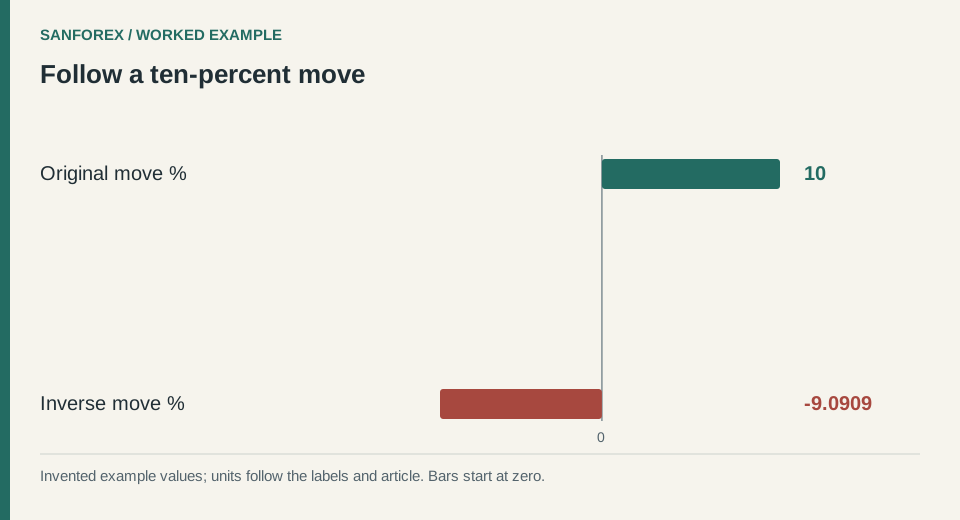
Worked example: Original move %: 10; Inverse move %: -9.0909. Invented values; units follow the row labels and article.
Open full-size diagram ↗Use a round-trip arithmetic check
Converting 110 USD at 0.909091 EUR per USD gives approximately 100 EUR. Converting that 100 EUR back at 1.10 USD per EUR returns 110 USD before rounding. This mathematical check assumes the same rate is available in both directions without fees. It does not model a transaction spread, so it cannot establish that a real conversion and reversal will preserve the starting amount.
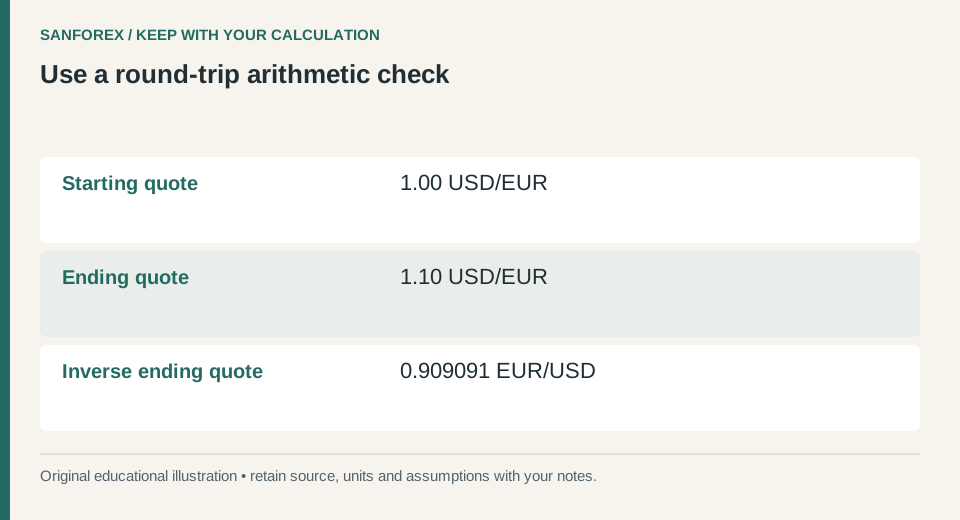
Calculation checklist: Starting quote: 1.00 USD/EUR; Ending quote: 1.10 USD/EUR; Inverse ending quote: 0.909091 EUR/USD. Preserve these definitions when reproducing the example.
Open full-size diagram ↗Keep benchmarks distinct from executable quotes
ECB reference rates are informational benchmarks. If you compare their movement with a provider quote, align quote direction, timestamps and currency units first. Preserve more precision during inversion than you display to a reader. Use SanForex’s custom-rate conversion to check multiplication with a stated scenario; it does not establish that a reciprocal price can be executed.
Sources and conventions
Examples are hypothetical. Worked examples state their formulas and assumptions in the article; our methodology explains the related calculators. Broker contract specifications determine actual lot, margin and execution conditions. These sources document definitions and data; a source link does not imply endorsement of SanForex or a trading service.
These materials are prepared with AI assistance and checked against worked examples and deterministic calculation tests where applicable. They are not an expert suitability assessment or investment advice.
Open currency converter tool ↗