Average exchange rates using the amounts converted
An average conversion rate for a set of transactions should reproduce total destination currency from total source currency under the chosen definition.
Ask what your average should reproduce
An average conversion rate for a set of transactions should reproduce total destination currency from total source currency under the chosen definition. An unweighted average treats a tiny transaction as equally important as a large one. When all rates share the same quote direction, weight them by the source amounts converted, not by the number of transactions.
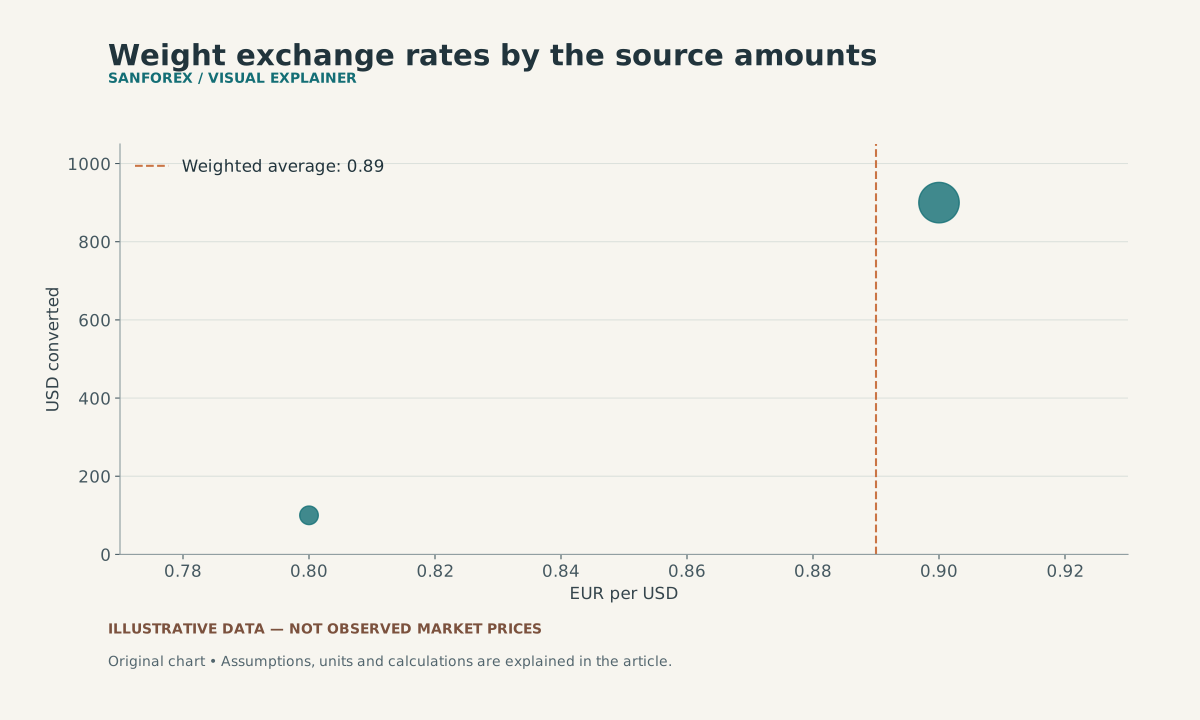
A 100 USD conversion at 0.80 and a 900 USD conversion at 0.90 yield a quantity-weighted rate of 0.89 EUR per USD. Marker sizes also scale with the source amounts.
Open full-size diagram ↗Compare equal-count and cash-weighted averages
Imagine converting 100 USD at 0.80 EUR per USD and 900 USD at 0.90 EUR per USD. The receipts are 80 EUR and 810 EUR, totaling 890 EUR for 1,000 USD. The cash-weighted rate is 0.89 EUR per USD. The unweighted rate, (0.80 + 0.90) ÷ 2 = 0.85, would imply only 850 EUR if applied to the total. The 40 EUR discrepancy exposes the wrong weighting for this purpose.
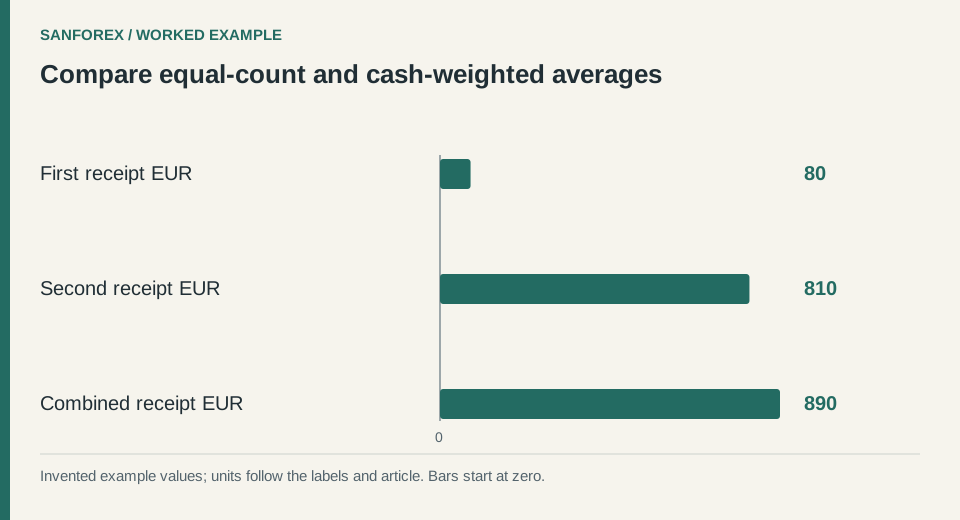
Worked example: First receipt EUR: 80; Second receipt EUR: 810; Combined receipt EUR: 890. Invented values; units follow the row labels and article.
Open full-size diagram ↗Keep fee treatment consistent
If fees reduce source amounts before conversion, decide whether your calculation describes the conversion rate or the all-in rate on total spending. Those require different denominators. Likewise, do not average one rate in EUR per USD with another in USD per EUR. Convert the units first and preserve enough precision to reproduce the actual totals within the stated rounding convention.
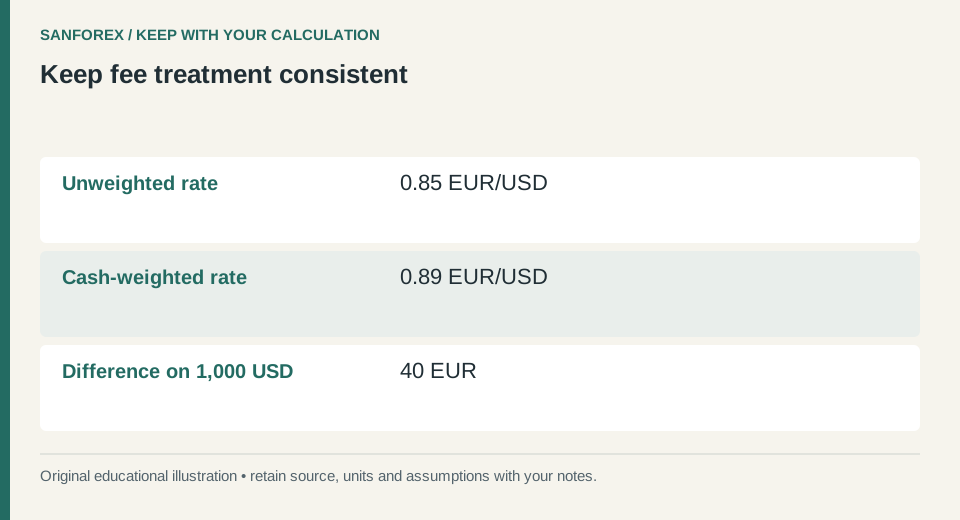
Calculation checklist: Unweighted rate: 0.85 EUR/USD; Cash-weighted rate: 0.89 EUR/USD; Difference on 1,000 USD: 40 EUR. Preserve these definitions when reproducing the example.
Open full-size diagram ↗Store the transaction-level evidence
Keep original source amount, converted amount, quote direction, conversion time and separately charged fees for each row. Summing the destination receipts and dividing by the corresponding source total is often the clearest cross-check. This is a descriptive average of the selected records, not an official historical fixing or a rate available for a new payment. SanForex’s converter can check each row, but it does not import a conversion ledger.
Sources and conventions
Examples are hypothetical. Worked examples state their formulas and assumptions in the article; our methodology explains the related calculators. Broker contract specifications determine actual lot, margin and execution conditions. These sources document definitions and data; a source link does not imply endorsement of SanForex or a trading service.
These materials are prepared with AI assistance and checked against worked examples and deterministic calculation tests where applicable. They are not an expert suitability assessment or investment advice.
Open currency converter tool ↗