Foreign-currency invoices: calculate sensitivity without a forecast
A fixed foreign-currency invoice can translate into different amounts in your reporting currency as an assumed rate changes.
Separate the obligation from its conversion
A fixed foreign-currency invoice can translate into different amounts in your reporting currency as an assumed rate changes. A sensitivity table asks what the arithmetic would be under several stated rates. It does not forecast which rate will occur or advise how to hedge. Keep the invoice amount and its currency unchanged across the scenarios.
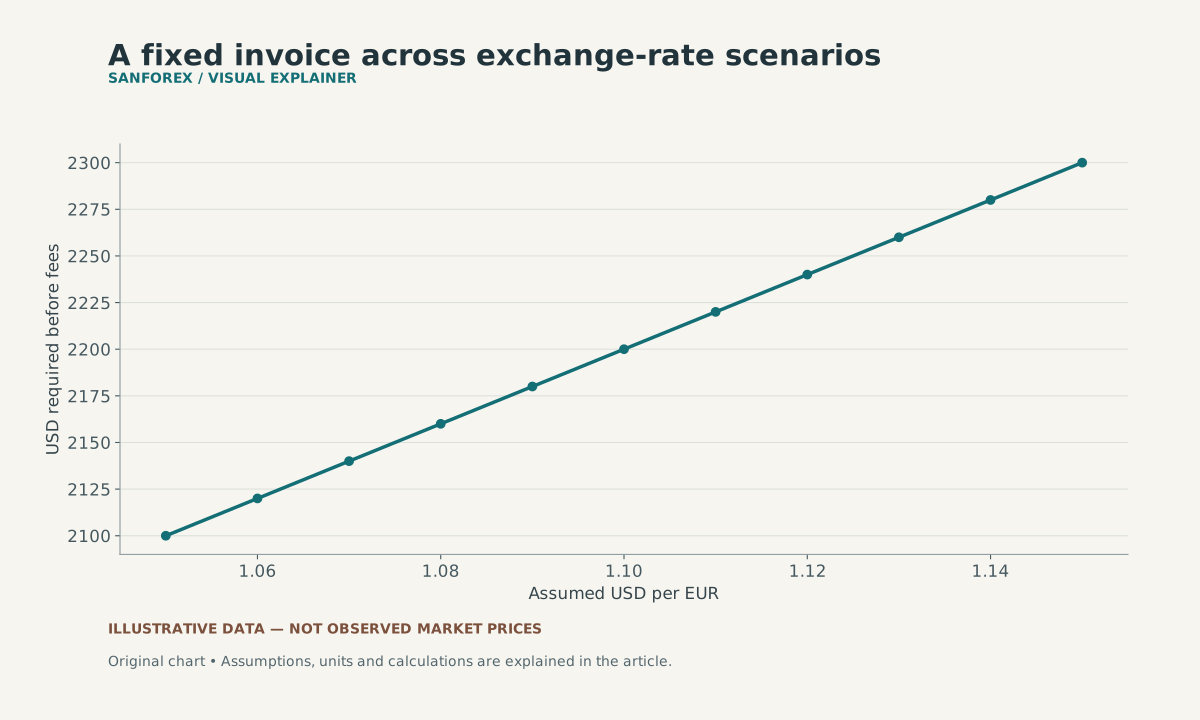
For a fixed 2,000 EUR invoice, assumed rates from 1.05 to 1.15 USD per EUR imply 2,100 to 2,300 USD. This is sensitivity to an input, not a time-series forecast.
Open full-size diagram ↗Build three hypothetical payment scenarios
Suppose an invoice requires 2,000 EUR and a budget is expressed in USD. At 1.05 USD per EUR the converted amount is 2,100 USD; at 1.10 it is 2,200 USD; at 1.15 it is 2,300 USD. Every 0.01 USD-per-EUR change alters the conversion by 20 USD because 2,000 × 0.01 = 20. The table excludes all payment charges and does not claim these rates are currently available.
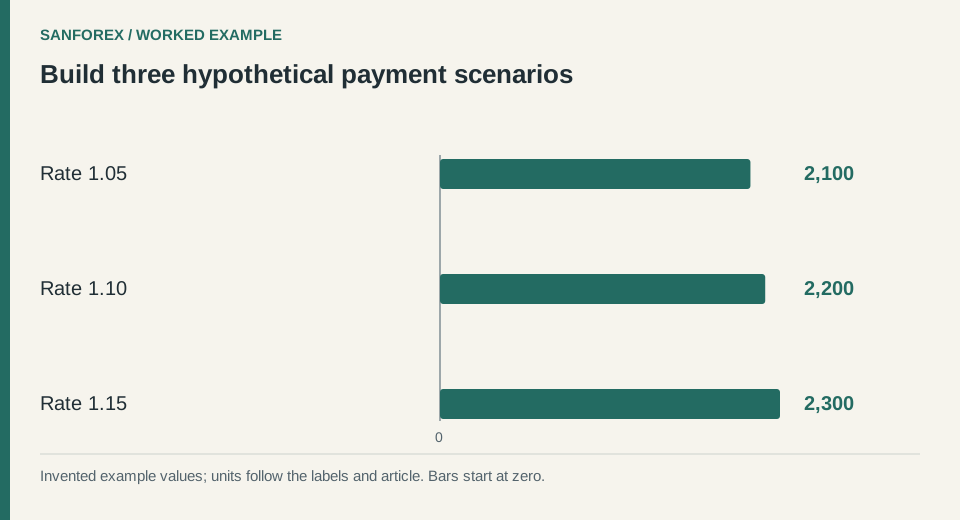
Worked example: Rate 1.05: 2100; Rate 1.10: 2200; Rate 1.15: 2300. Invented values; units follow the row labels and article.
Open full-size diagram ↗Avoid confusing a receivable with a payable
For someone paying the EUR invoice from USD, a larger USD-per-EUR rate raises the modeled USD requirement. For someone receiving EUR and converting it into USD, the same rate change raises the modeled USD proceeds. The multiplication is identical; the business interpretation differs. Label the cash-flow direction instead of describing every rise as either favorable or unfavorable.
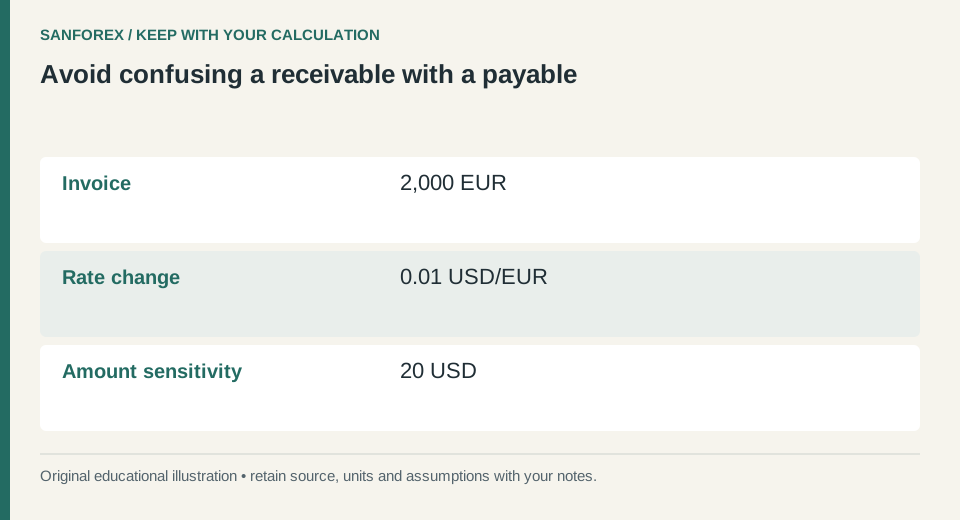
Calculation checklist: Invoice: 2,000 EUR; Rate change: 0.01 USD/EUR; Amount sensitivity: 20 USD. Preserve these definitions when reproducing the example.
Open full-size diagram ↗Preserve the assumptions when sharing the table
Record invoice currency, due date, assumed conversion date, quote direction and excluded charges. Reference data can supply an informational comparison but cannot lock in a future payment rate. Enter each scenario separately in the currency converter and retain the three outputs. If you need an accounting or tax value, determine the applicable rules independently; this worksheet is only a sensitivity calculation.
Sources and conventions
Examples are hypothetical. Worked examples state their formulas and assumptions in the article; our methodology explains the related calculators. Broker contract specifications determine actual lot, margin and execution conditions. These sources document definitions and data; a source link does not imply endorsement of SanForex or a trading service.
These materials are prepared with AI assistance and checked against worked examples and deterministic calculation tests where applicable. They are not an expert suitability assessment or investment advice.
Open currency converter tool ↗