Participation and employment-population ratios answer different questions
Labor-force participation compares the labor force with the relevant population.
Keep the two numerators separate
Labor-force participation compares the labor force with the relevant population. The employment-population ratio compares employed people with that population. BLS defines the population used for US household statistics; do not substitute a country’s total population without checking coverage. The gap between the ratios is related to unemployment, but is not itself the unemployment rate.
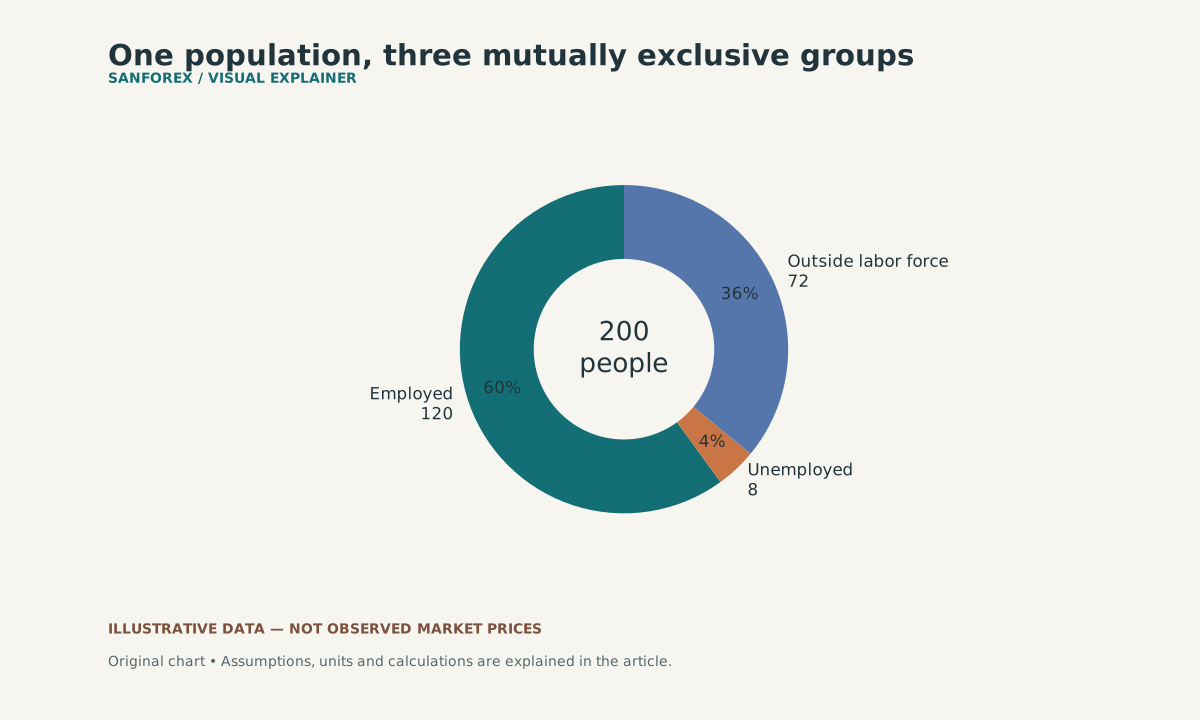
In a hypothetical population of 200, 120 are employed, 8 unemployed and 72 outside the labor force. Pie shares use population; the unemployment rate instead divides 8 by the 128-person labor force.
Open full-size diagram ↗Calculate three ratios from one hypothetical population
Assume a relevant population of 200 people, with 120 employed and eight unemployed. The labor force is 128. Participation is 128 ÷ 200 = 64%; the employment-population ratio is 120 ÷ 200 = 60%; unemployment is 8 ÷ 128 = 6.25%. Subtracting 60% from 64% gives four percentage points, not a 4% unemployment rate, because unemployment uses a different denominator.
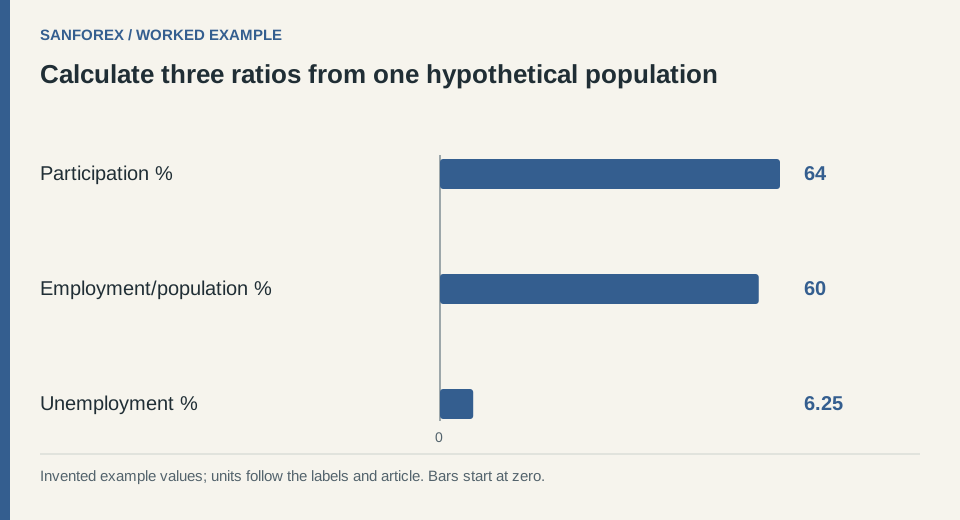
Worked example: Participation %: 64; Employment/population %: 60; Unemployment %: 6.25. Invented values; units follow the row labels and article.
Open full-size diagram ↗Make the population categories reconcile
The remaining 72 people are outside the labor force in this example. Adding employed, unemployed and outside-labor-force categories returns 200. A reconciliation table catches errors that a single chart may hide. Use unrounded counts where possible because published rounded percentages need not recombine exactly.
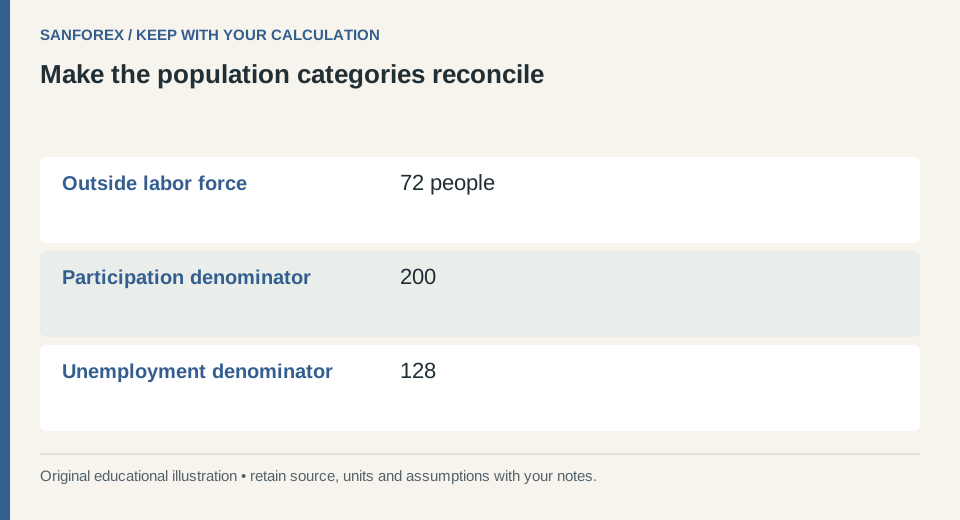
Calculation checklist: Outside labor force: 72 people; Participation denominator: 200; Unemployment denominator: 128. Preserve these definitions when reproducing the example.
Open full-size diagram ↗Compare consistent populations
Age coverage, population composition and statistical definitions can affect comparisons. A change in a ratio does not identify its cause without additional evidence. Record population definition, time period and adjustment basis beside the values. This is a denominator exercise, not a prediction about wages, policy or exchange rates.
Sources and conventions
Examples are hypothetical. Worked examples state their formulas and assumptions in the article; our methodology explains the related calculators. Broker contract specifications determine actual lot, margin and execution conditions. These sources document definitions and data; a source link does not imply endorsement of SanForex or a trading service.
These materials are prepared with AI assistance and checked against worked examples and deterministic calculation tests where applicable. They are not an expert suitability assessment or investment advice.
Open trading journal tool ↗