Payroll jobs and employed people are not interchangeable
BLS produces employment measures from the establishment survey and the household survey.
Know which survey a headline describes
BLS produces employment measures from the establishment survey and the household survey. Their coverage and concepts differ. Payroll statistics count jobs within their scope, while household employment measures people. Two series can therefore move differently without either being a simple arithmetic mistake.
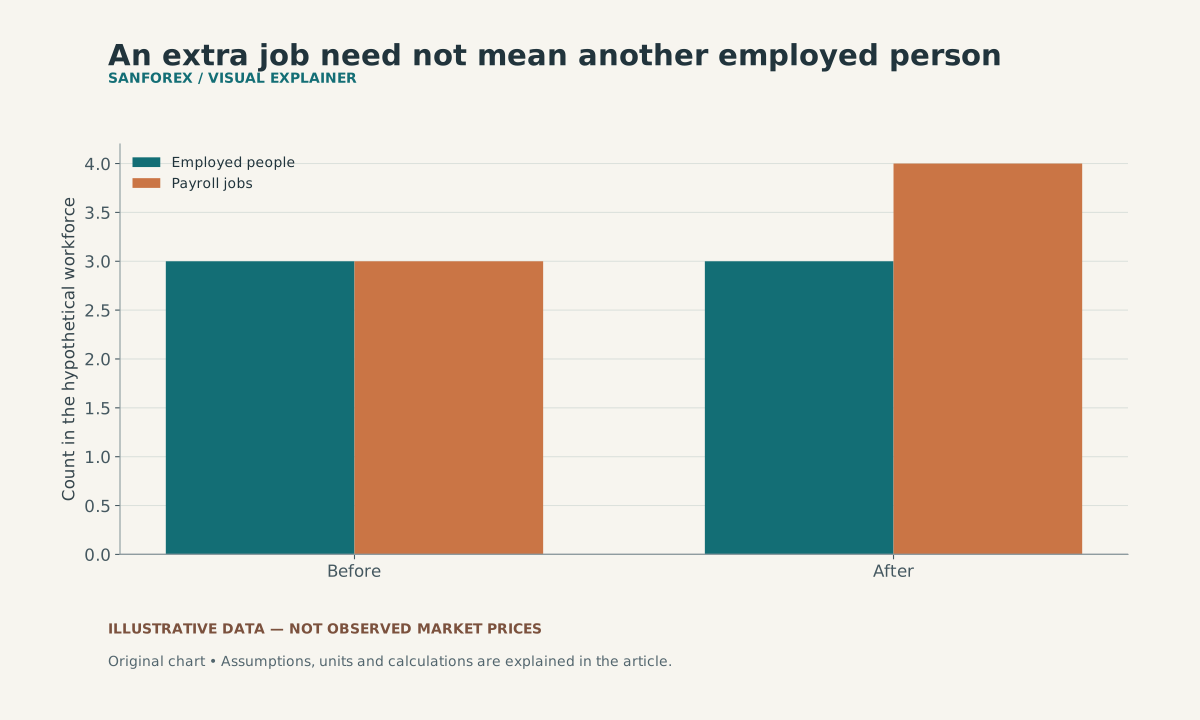
One person adding a payroll job raises the toy job count from three to four, while the number of employed people stays three. Survey coverage and weighting are not modeled here.
Open full-size diagram ↗Count a miniature hypothetical workforce
Imagine three people: Alex has two payroll jobs, Bea has one payroll job, and Cam is self-employed with no payroll job in this simplified example. The group contains three employed people and three payroll jobs. Now Alex takes a third payroll job while the other arrangements stay unchanged. Payroll jobs rise to four while employed people remain three. The example explains counting units, not official survey weighting.
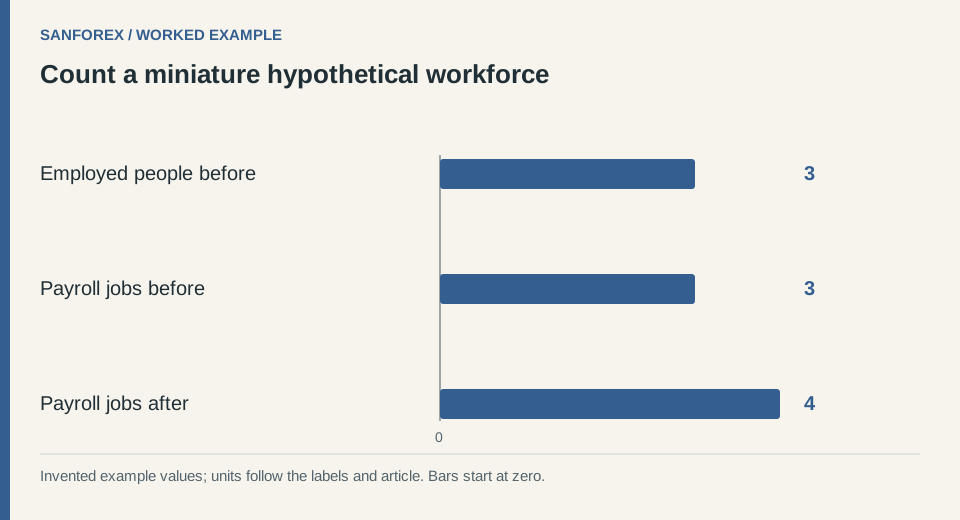
Worked example: Employed people before: 3; Payroll jobs before: 3; Payroll jobs after: 4. Invented values; units follow the row labels and article.
Open full-size diagram ↗Do not infer a complete reconciliation from one difference
Multiple jobholding is only one conceptual distinction. Coverage, timing, sampling, revisions and other measurement differences matter in actual statistics. The official BLS comparison explains these boundaries. Subtracting the two published totals does not directly measure self-employment or the number of second jobs.
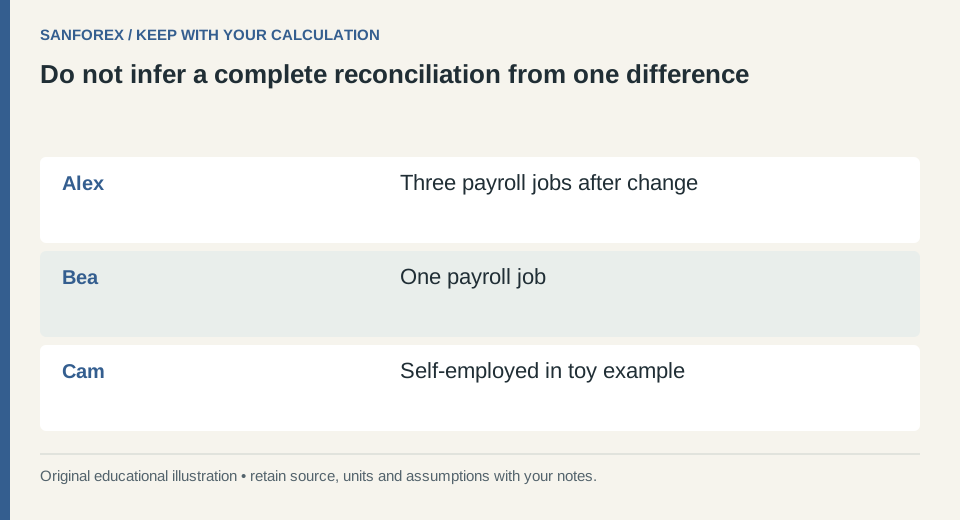
Calculation checklist: Alex: Three payroll jobs after change; Bea: One payroll job; Cam: Self-employed in toy example. Preserve these definitions when reproducing the example.
Open full-size diagram ↗Create a source-aware employment note
Record the survey name, whether the unit is jobs or people, the reference period and the revision vintage. Label a change in thousands separately from a percentage change. Before comparing two headlines, verify that they refer to the same survey. Neither series alone gives a mechanical rule for market direction.
Sources and conventions
Examples are hypothetical. Worked examples state their formulas and assumptions in the article; our methodology explains the related calculators. Broker contract specifications determine actual lot, margin and execution conditions. These sources document definitions and data; a source link does not imply endorsement of SanForex or a trading service.
These materials are prepared with AI assistance and checked against worked examples and deterministic calculation tests where applicable. They are not an expert suitability assessment or investment advice.
Open trading journal tool ↗