A policy target range, its midpoint and an observed rate
A policy target range is a pair of boundaries.
Do not collapse different rate concepts
A policy target range is a pair of boundaries. Its midpoint is a calculated summary, while an observed market rate is a separate statistic. Federal Reserve explanations distinguish a federal-funds target range from the mechanisms and market rates associated with implementation. The midpoint should not be presented as a directly observed borrowing quote.
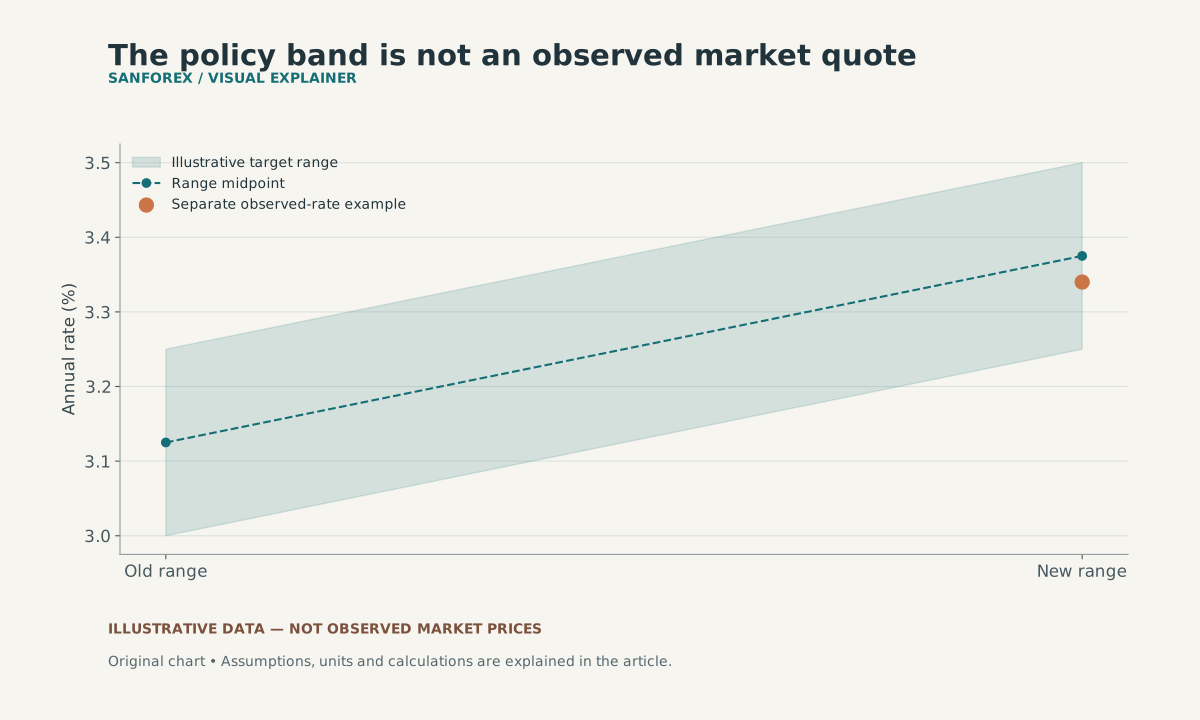
A hypothetical target band shifts from 3.00–3.25% to 3.25–3.50%. The midpoint rises 25 basis points; a separate 3.34% observation is not the midpoint. These are not current policy rates.
Open full-size diagram ↗Calculate an invented range change
Suppose an illustrative range moves from 3.00–3.25% to 3.25–3.50%. Its midpoint moves from 3.125% to 3.375%, a change of 0.25 percentage points or 25 basis points. The range width remains 0.25 percentage points. Adding the two boundaries without dividing by two would produce 6.25% for the original range, which is not a meaningful midpoint.
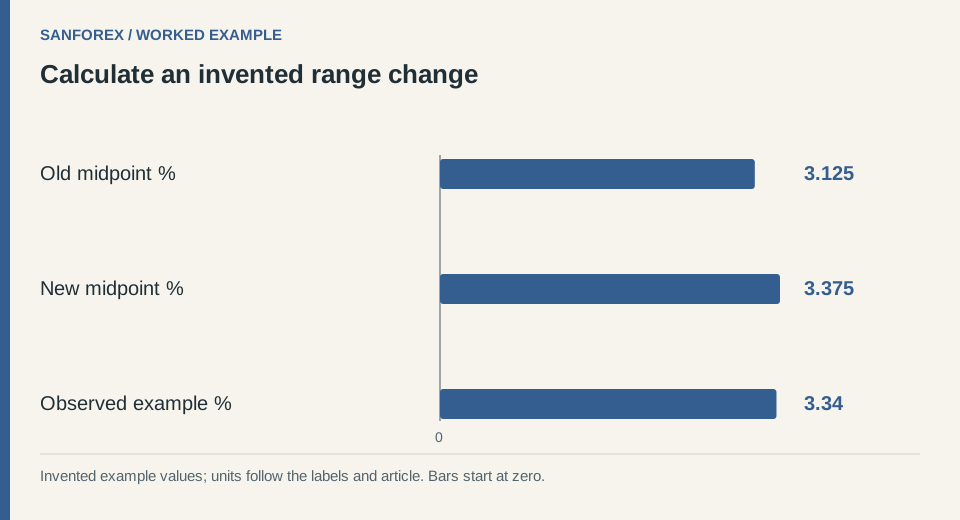
Worked example: Old midpoint %: 3.125; New midpoint %: 3.375; Observed example %: 3.34. Invented values; units follow the row labels and article.
Open full-size diagram ↗Keep an observed rate on its own row
If a hypothetical observed overnight rate is 3.34% during the second range, record 3.34% as the observation and 3.375% as the midpoint. The difference is −0.035 percentage points, or −3.5 basis points. This is only a comparison of stated numbers; it does not explain policy transmission or diagnose the functioning of a market.
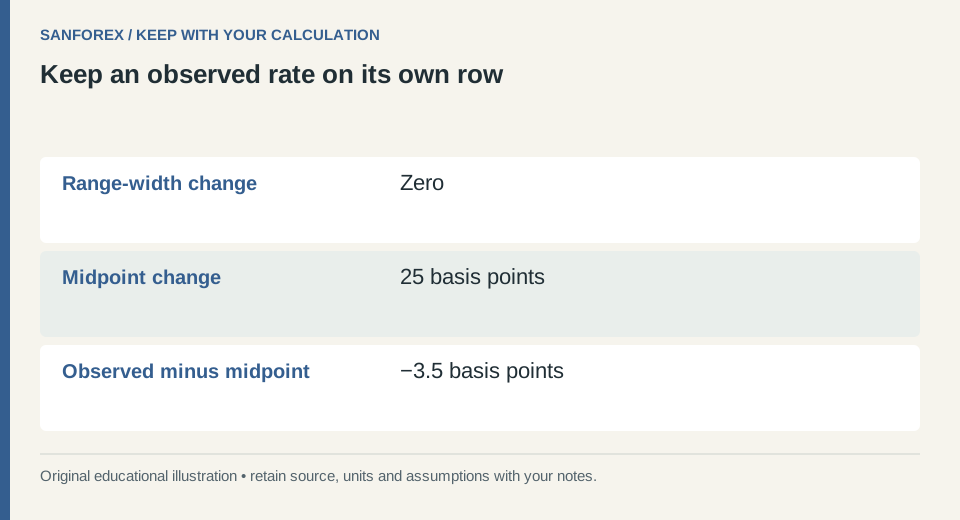
Calculation checklist: Range-width change: Zero; Midpoint change: 25 basis points; Observed minus midpoint: −3.5 basis points. Preserve these definitions when reproducing the example.
Open full-size diagram ↗Preserve dates and definitions
Record announcement date, effective date, rate tenor, range boundaries and the source of any observed series. Do not use these invented levels as current policy information. A target rate is not the rate a particular retail customer will necessarily receive or pay, and no currency-price prediction follows mechanically from this worksheet.
Sources and conventions
Examples are hypothetical. Worked examples state their formulas and assumptions in the article; our methodology explains the related calculators. Broker contract specifications determine actual lot, margin and execution conditions. These sources document definitions and data; a source link does not imply endorsement of SanForex or a trading service.
These materials are prepared with AI assistance and checked against worked examples and deterministic calculation tests where applicable. They are not an expert suitability assessment or investment advice.
Open risk / reward tool ↗