Quarterly GDP growth: what an annualized rate means
BEA commonly reports quarterly GDP growth at annual rates.
Separate the quarter from the reporting convention
BEA commonly reports quarterly GDP growth at annual rates. Annualization expresses the pace that would result if the same quarterly growth factor repeated four times. It is not a claim that the entire reported annualized increase already occurred within that quarter, and it is not a forecast of the next three quarters.
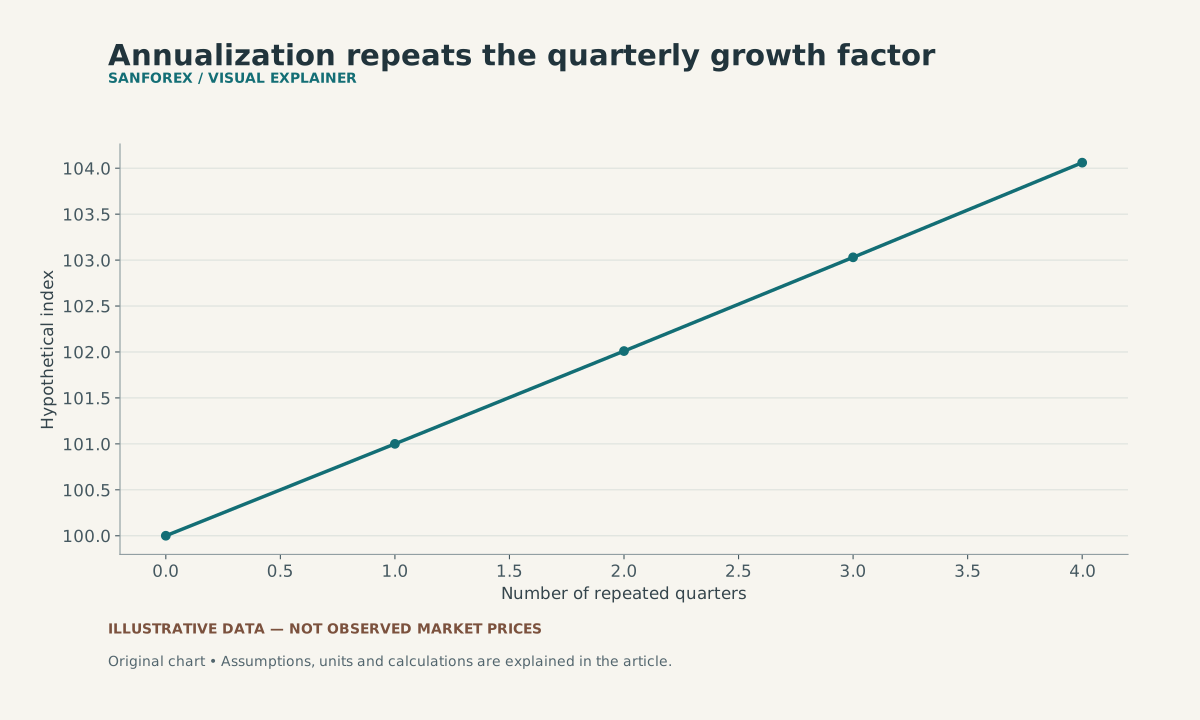
Repeating a 1% quarterly increase four times takes an index from 100 to 104.060401. Repetition is the annualization assumption, not a forecast of the next quarters.
Open full-size diagram ↗Calculate a simple annualized example
Suppose a hypothetical real-output index rises from 100 to 101 over one quarter. The quarterly change is 1%. Repeating that factor four times gives 1.01 to the fourth power = 1.04060401, or approximately 4.06% annualized growth. Multiplying 1% by four gives a close approximation, but ignores compounding. For a −1% quarter, 0.99 to the fourth power implies approximately −3.94% annualized.
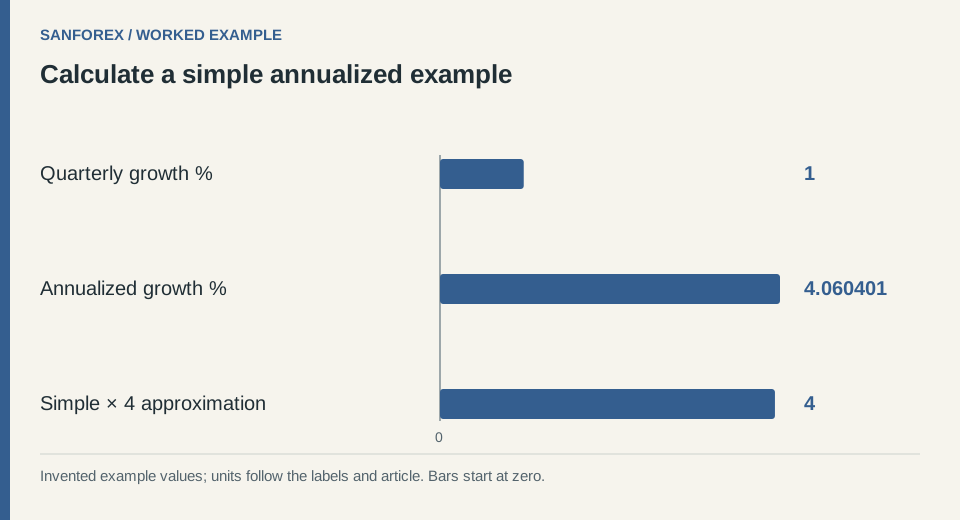
Worked example: Quarterly growth %: 1; Annualized growth %: 4.0604; Simple × 4 approximation: 4. Invented values; units follow the row labels and article.
Open full-size diagram ↗Reverse the transformation when needed
To recover a quarterly factor from a stated annualized factor, take its fourth root. For example, the fourth root of 1.04060401 is 1.01. Do not subtract four percentage points or divide the index level by four. Compare releases using the same convention before deciding which reported pace is larger.
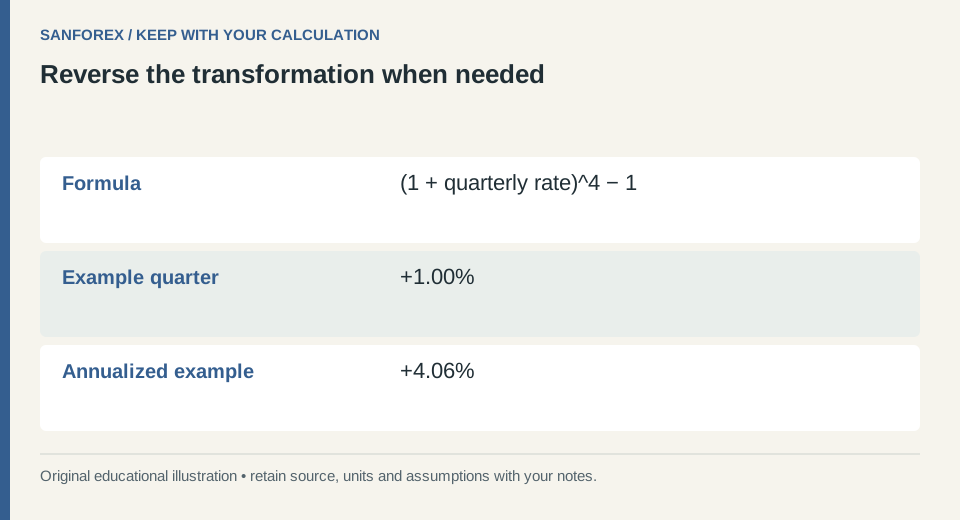
Calculation checklist: Formula: (1 + quarterly rate)^4 − 1; Example quarter: +1.00%; Annualized example: +4.06%. Preserve these definitions when reproducing the example.
Open full-size diagram ↗Label the date and vintage
Record the reference quarter, annualized or nonannualized basis, real or nominal status, and estimate vintage. Revised inputs can change published growth. This worksheet teaches the transformation only; it does not replicate BEA’s source estimation or imply any currency-market response.
Sources and conventions
Examples are hypothetical. Worked examples state their formulas and assumptions in the article; our methodology explains the related calculators. Broker contract specifications determine actual lot, margin and execution conditions. These sources document definitions and data; a source link does not imply endorsement of SanForex or a trading service.
These materials are prepared with AI assistance and checked against worked examples and deterministic calculation tests where applicable. They are not an expert suitability assessment or investment advice.
Open risk / reward tool ↗